Our Location
1103A Tianhui Building, Yeqin 1st Road, Longcheng Street, Shenzhen, Guangdong, China
1103A Tianhui Building, Yeqin 1st Road, Longcheng Street, Shenzhen, Guangdong, China
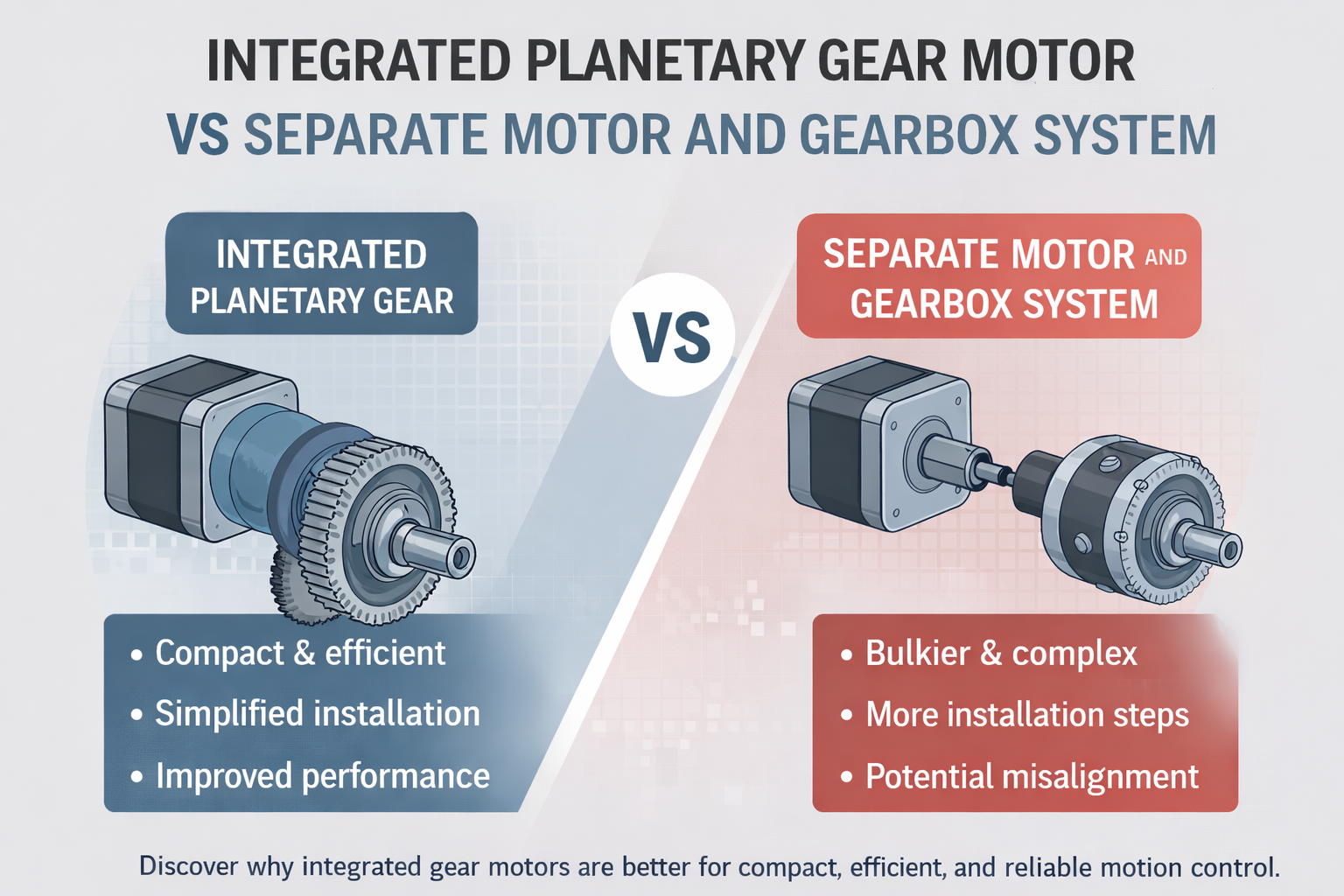
In modern engineering applications, selecting the right motor and gearbox configuration is critical to optimizing performance, reliability, and efficiency. Integrated planetary gear motors provide several key advantages over traditional separate motor and gearbox systems. This article explores the benefits of integrated planetary gear motors, including space efficiency, improved performance, reduced complexity, and why they are often the preferred choice for many motion control systems.
An integrated planetary gear motor combines a planetary gearbox and a motor into a single compact unit, unlike traditional systems where a separate motor and gearbox are connected via coupling and external components. Integrated systems are designed to deliver higher performance while reducing complexity, making them ideal for applications requiring precise and reliable motion control.
Integrated planetary gear motors are much more compact compared to separate motor and gearbox systems. By combining both components into one unit, space is saved, and the need for additional mounting brackets and coupling components is eliminated. This is especially beneficial in applications where space is constrained, such as in robotics or small industrial machinery.
Example: In **robotic arms**, where compactness and precision are paramount, integrated planetary gear motors provide the necessary torque and speed control in a smaller form factor, eliminating the need for bulky external gearboxes and motors.
Learn more about NEMA 17 Integrated Planetary Gear Motors
Integrated planetary gear motors offer optimized alignment between the motor and gearbox, significantly reducing power loss, which is common in separate motor-gearbox configurations. In traditional setups, misalignments between components can cause additional friction and energy loss, reducing overall system efficiency.
Example: In **CNC machinery**, where precise control of speed and torque is crucial, integrated motor-gearbox systems reduce energy loss, enhancing system efficiency and responsiveness. This leads to improved performance and lower operational costs.
Explore how integrated motors improve efficiency in CNC machinery
While integrated planetary gear motors may come with a higher upfront cost, they offer significant savings over time. Separate systems require additional mounting hardware, couplings, and alignment procedures, which increases both initial and maintenance costs.
Example: In **automated production lines**, the reduction in installation time and the absence of extra components for coupling and alignment significantly lower the total system cost, especially in mass production environments.
Integrated systems are easier to install and maintain compared to separate motor and gearbox configurations. The elimination of external couplings and mounting components simplifies the installation process. Additionally, integrated motors generally require less maintenance because there are fewer moving parts and no alignment issues between the motor and gearbox.
Example: In **automated conveyor systems**, the simplicity of an integrated planetary gear motor reduces setup times, while the reduced complexity makes maintenance easier and less costly over time.
Example: An integrated planetary gear motor eliminates alignment issues commonly seen in separate motor + gearbox assemblies. Our NEMA 17 stepper motor gearbox is a typical integrated solution used in CNC Z-axis and robotic joints.
The direct connection between the motor and gearbox in integrated systems ensures optimal alignment, reducing wear and tear over time. Separate systems often experience misalignment, which leads to excessive wear and a shorter system lifespan. By eliminating these issues, integrated planetary gear motors offer greater durability and reliability, especially in harsh industrial environments.
Example: In **high-torque applications**, such as robotic arms in manufacturing, integrated systems tend to last longer, even under heavy loads, due to their robust design.
Integrated planetary gear motors offer smoother and more precise control. The synchronization between the motor and gearbox allows for superior torque control and speed regulation. In applications that require precise positioning, such as **high-precision robotics**, integrated systems provide better performance compared to separate components.
Example: A **stepper motor with integrated planetary gearbox** in a **robotic arm** allows for precise, repeatable movements without the risk of performance degradation due to system misalignment, resulting in more accurate automated tasks.
Encoder selection is often overlooked when comparing integrated and separate drive solutions. Our encoder in gear motor guide explains when feedback is necessary and when an open-loop stepper system is sufficient.
Integrated planetary gear motors are ideal for a wide range of applications requiring compactness, precision, and reliability:
While separate motor and gearbox systems may still be suitable for specific applications, integrated planetary gear motors offer numerous advantages in terms of efficiency, compactness, cost-effectiveness, and ease of use. For applications where space, precision, and efficiency are critical, integrated systems are the superior choice.
Integrated planetary gear motors combine the best features of both motors and gearboxes into one compact, efficient unit. With advantages such as improved performance, simplified installation, and reduced system complexity, they are ideal for a wide range of modern applications in robotics, automation, and motion control systems. Understanding the benefits of integrated systems allows engineers to make more informed decisions and optimize designs for both performance and cost.
An integrated planetary gear motor combines both the motor and planetary gearbox into a single unit, whereas traditional systems use separate components that need to be connected via additional coupling mechanisms, requiring more space and creating more points of failure.
Yes, integrated planetary gear motors are more efficient because they eliminate misalignment and unnecessary energy losses that occur in separate motor-gearbox configurations. The optimized alignment between the motor and gearbox reduces friction and energy waste.
Absolutely. Integrated planetary gear motors are commonly used in high-precision applications such as robotics, CNC machines, and automated systems due to their ability to deliver smooth and accurate motion control.
In industrial automation, integrated planetary gear motors offer reduced complexity, better space efficiency, and lower overall system costs. They also require less maintenance and provide more reliable, precise motion control, making them ideal for automated production lines and robotics.
While integrated planetary gear motors offer many advantages, they may not be suitable for all applications. For systems requiring extreme flexibility or customization, separate components may be a better fit. However, for most applications, the benefits of integration far outweigh the disadvantages.


[…] modern closed loop stepper systems, IO control is most commonly implemented in integrated gear motor architectures , where the motor, driver, encoder, and gearbox are designed as a unified motion […]