Our Location
1103A Tianhui Building, Yeqin 1st Road, Longcheng Street, Shenzhen, Guangdong, China
1103A Tianhui Building, Yeqin 1st Road, Longcheng Street, Shenzhen, Guangdong, China
Selecting the correct control method is a critical engineering decision when designing closed loop stepper motor systems. IO control and pulse control serve very different application scenarios, and choosing the wrong approach often leads to unnecessary complexity, unstable motion, or cost overruns.
This guide explains when IO control is technically superior to pulse control, based on real motion system architectures rather than controller marketing terminology.
IO control refers to triggering predefined motion commands through digital input signals such as start, stop, direction change, homing, or preset position selection. Motion profiles are stored inside the integrated driver or controller, eliminating the need for continuous pulse generation from an external motion controller.
In modern closed loop stepper systems, IO control is most commonly implemented in integrated gear motor architectures, where the motor, driver, encoder, and gearbox are designed as a unified motion module.
Pulse control relies on external motion controllers (PLC, CNC, or motion cards) to generate high-frequency step and direction signals. Each pulse corresponds to a defined motor increment, and motion accuracy depends heavily on pulse timing, signal integrity, and controller performance.
Pulse control offers maximum flexibility for interpolation, synchronized multi-axis motion, and complex trajectory planning, but requires significantly higher system-level engineering effort.
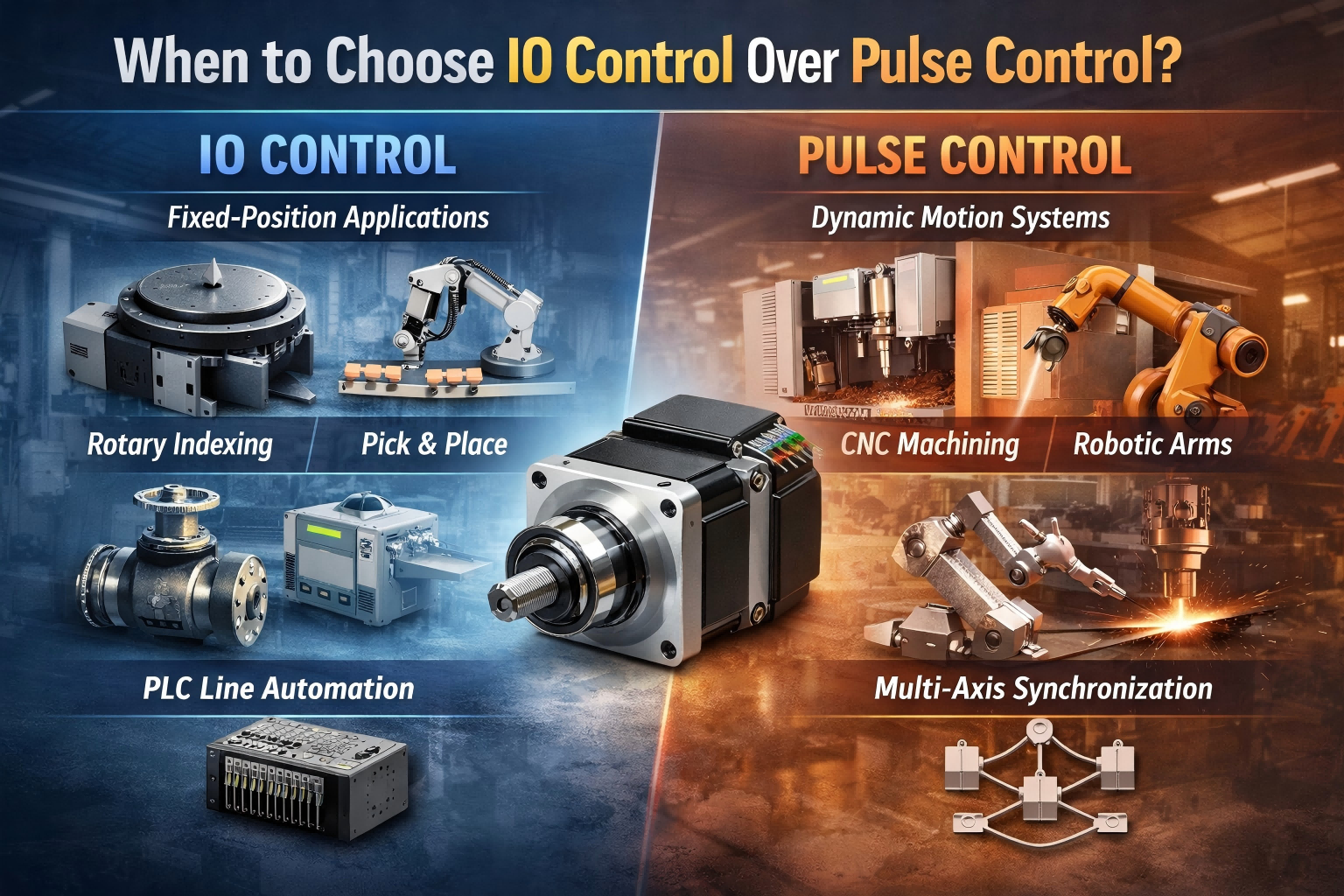
IO control is the preferred solution when motion requirements are repetitive, discrete, and well-defined. It significantly reduces wiring complexity, commissioning time, and software development cost.
Applications such as rotary indexing tables, valve actuation, material positioning, and pick-and-place units often operate between fixed positions with repeatable motion cycles. In these systems, IO-triggered motion profiles are more robust than continuous pulse streams.
Because positioning repeatability is usually more critical than absolute path accuracy, IO-controlled systems are frequently combined with low backlash gearbox designs rather than complex closed-loop interpolation algorithms.
In PLC-driven automation environments, IO control allows the PLC to act as a logical sequence controller rather than a motion generator. This greatly reduces scan-time limitations and avoids pulse loss caused by PLC task scheduling.
A common misunderstanding is assuming that pulse control always delivers higher motion accuracy than IO control. In reality, system accuracy is often dominated by mechanical factors rather than control signal resolution.
As discussed in our detailed backlash vs accuracy vs repeatability analysis, reducing backlash and improving repeatability often has a greater impact on positioning performance than increasing pulse frequency.
Pulse control is still essential for applications requiring continuous interpolation, multi-axis synchronization, or dynamic speed profiling, such as CNC machines, laser cutting systems, and robotic arms.
If your system requires coordinated motion between axes or real-time trajectory adjustments, pulse-based control with a dedicated motion controller is unavoidable.
If you are designing a compact closed loop system with simplified wiring and predefined motion logic, an integrated closed loop stepper motor with onboard driver and encoder provides a robust engineering solution.
View Closed Loop Stepper Motor Solutions →
IO control should be used when the application requires simple, fixed motion sequences and does not rely on continuous pulse-based positioning.
No. In closed loop integrated stepper motors, encoder feedback ensures accuracy regardless of whether IO or pulse control is used.
IO control reduces wiring complexity, avoids pulse timing issues, and improves reliability in PLC-based automation systems.
Yes. Many closed loop integrated stepper motors support both control modes, selectable via wiring or configuration.
When selecting between IO control and pulse control, engineers should also consider gear ratio selection, torsional stiffness, and load inertia matching. These factors are explained in detail in our planetary gearbox selection guide, which is widely referenced in precision motion design.