Our Location
1103A Tianhui Building, Yeqin 1st Road, Longcheng Street, Shenzhen, Guangdong, China
1103A Tianhui Building, Yeqin 1st Road, Longcheng Street, Shenzhen, Guangdong, China
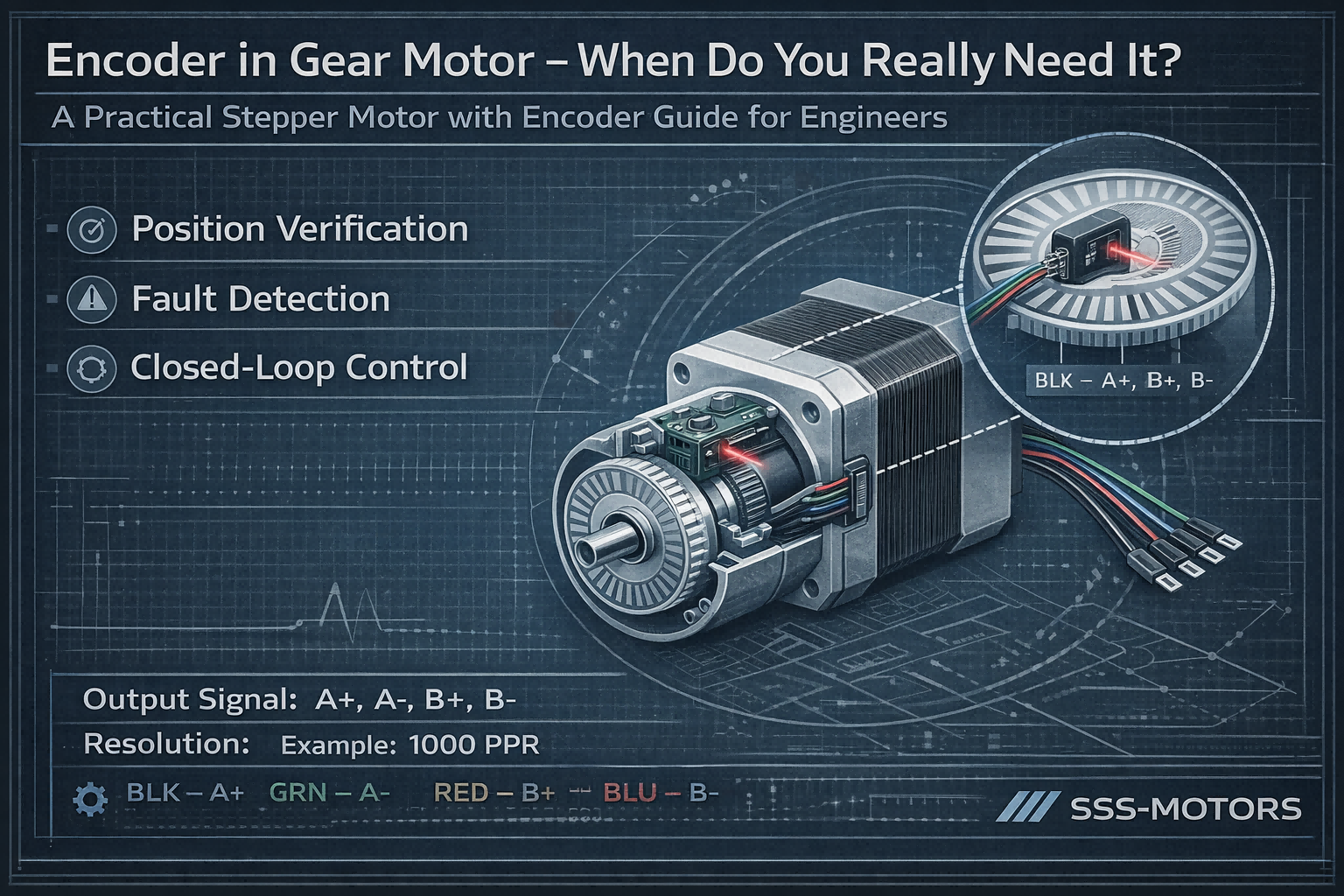
Encoders are often added to gear motors by default, but in many stepper-driven systems, they are unnecessary, costly, or even misunderstood. This stepper motor with encoder guide explains when an encoder is truly required, and when an open-loop stepper motor is the better engineering choice.
An encoder measures shaft position, speed, or direction by generating feedback signals. In a gear motor system, the encoder can be mounted on:
Each mounting position provides different feedback characteristics and accuracy implications.
One of the most common engineering myths is that adding an encoder automatically improves positioning accuracy. In reality:
This is why low-backlash planetary gearboxes often matter more than encoder resolution.
An encoder becomes necessary when the system must detect or correct position loss. Typical use cases include:
In these scenarios, a stepper motor with encoder provides monitoring and recovery capability.
For many industrial and automation systems, an encoder adds no real benefit. Examples include:
In these cases, an open-loop stepper motor with a properly selected gearbox often outperforms a poorly tuned closed-loop system.
Encoder placement significantly affects system behavior:
For high-precision positioning, output-shaft encoders combined with low-backlash planetary gearboxes offer the most meaningful performance improvement.
Modern closed-loop stepper motors blur the line between stepper and servo systems. However:
This makes closed-loop stepper motors ideal for mid-range automation systems.
A pick-and-place system using a NEMA 17 planetary gear motor experienced random position drift. The issue was not step loss, but gearbox backlash during direction reversal.
Solution:
Result: Positioning repeatability improved by 40%, without changing motor or controller.
Do not ask: “Does this motor have an encoder?” Ask instead: “What problem am I trying to solve?”
Encoders are powerful tools — but only when applied for the right reason.
No. An encoder only detects step loss; it does not prevent it unless paired with closed-loop control.
Not necessarily. Low-backlash planetary gearboxes often provide better real-world accuracy than adding an encoder alone.
Output-side encoders provide true load position feedback but increase system cost and mechanical complexity.
In many medium-speed, medium-precision applications, yes — especially where holding torque is critical.


[…] → Learn more: Stepper Motor with Encoder: Engineering Guide […]
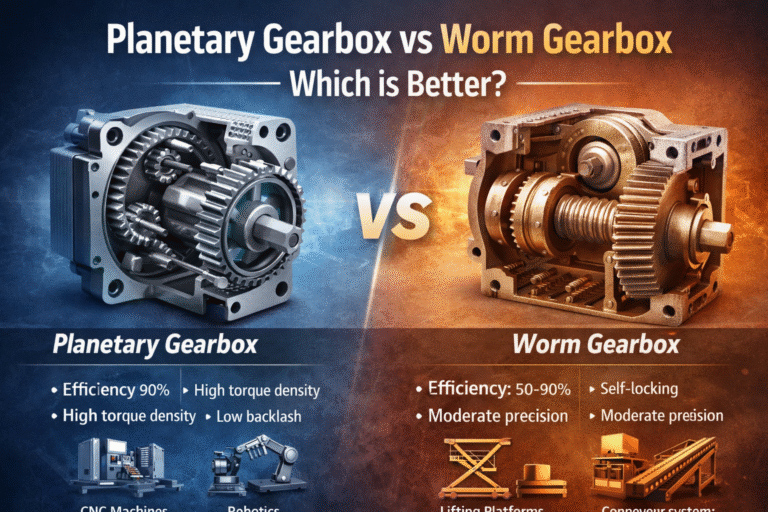
[…] engineers try to compensate backlash issues by adding feedback devices. As explained in our stepper motor with encoder guide, an encoder can help detect lost motion, but it cannot eliminate mechanical backlash […]
[…] selection is often overlooked when comparing integrated and separate drive solutions. Our encoder in gear motor guide explains when feedback is truly required, and when an open-loop stepper system is […]