Our Location
1103A Tianhui Building, Yeqin 1st Road, Longcheng Street, Shenzhen, Guangdong, China
1103A Tianhui Building, Yeqin 1st Road, Longcheng Street, Shenzhen, Guangdong, China
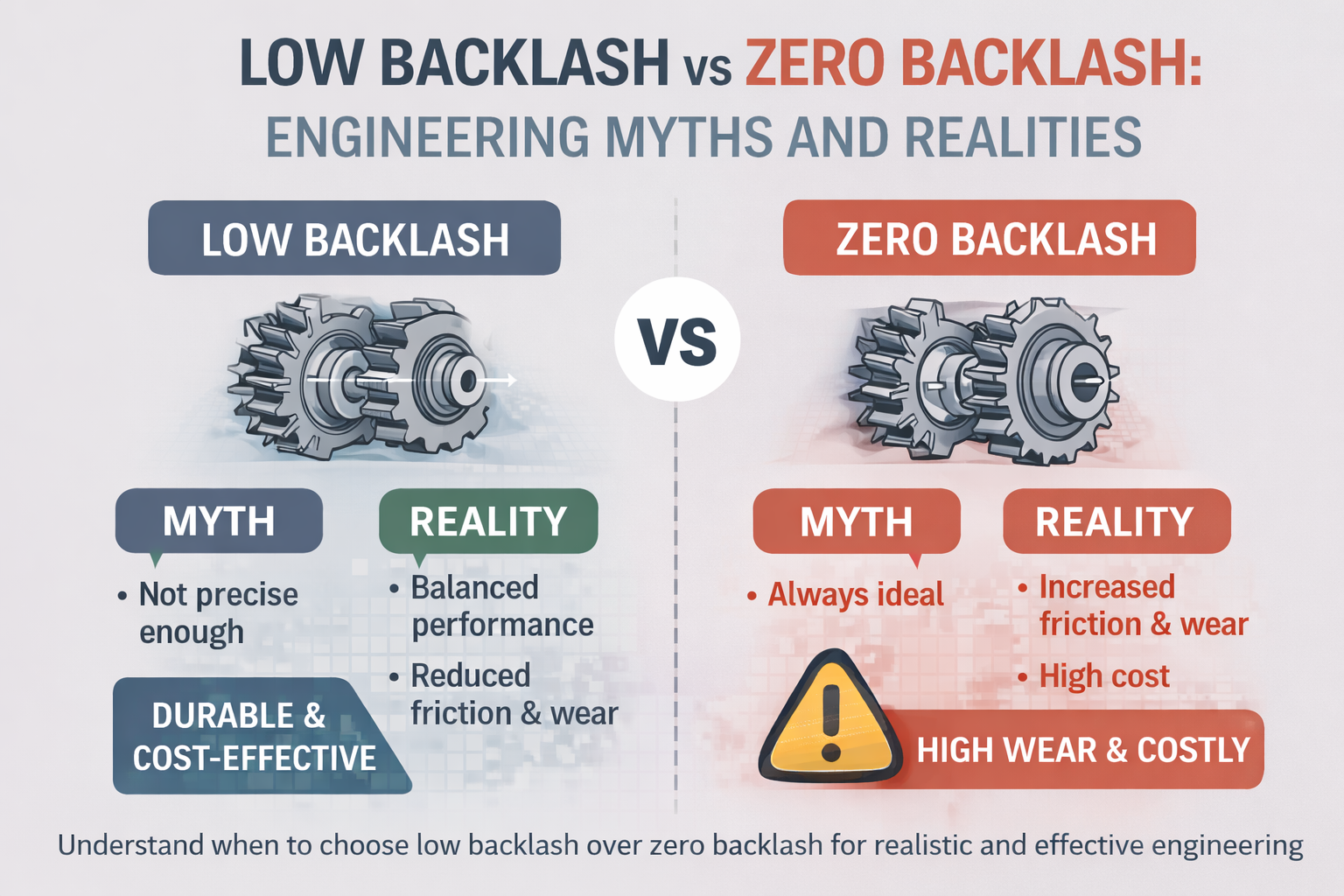
Backlash is a critical consideration when designing gearboxes and motion control systems. In many engineering discussions, the terms “low backlash” and “zero backlash” are used interchangeably, but they refer to two very different characteristics. This article will explore the differences between these two concepts, debunk some common engineering myths, and explain why “zero backlash” is often not the best solution for every application.
Backlash refers to the play or lost motion between gear teeth when the direction of rotation is changed. This occurs due to the clearance between meshing gears, and it can lead to inaccuracies in position, particularly in high-precision applications.
For example, in a robotic arm, backlash could cause delays in response when changing directions, affecting the accuracy of movements. In some cases, such as for automated machining, backlash can result in poor surface finishes or dimensional inaccuracies.
Before we dive into the differences, it’s essential to understand the implications of both low and zero backlash in gear systems.
Low backlash means that the clearance between the gear teeth is minimal, but still present. It is typically measured in degrees of angular movement. Systems with low backlash exhibit less play, reducing the delay in motion transfer, but there is still some measurable clearance.
Example: A NEMA 17 gear motor with a low backlash planetary gearbox offers smoother performance and higher precision compared to standard gear systems. However, some amount of movement will still occur between gears during direction changes.
Learn more about NEMA 17 Low Backlash Gear Motors
Zero backlash refers to a system in which there is no measurable clearance between gear teeth. Achieving this often requires highly precise manufacturing processes, and while it eliminates backlash, it introduces other challenges such as increased friction, wear, and heat generation.
Example: A zero backlash planetary gearbox in an industrial robot might be advertised as offering perfect positional accuracy. However, the increased friction and potential wear can reduce the motor’s lifespan and efficiency over time.
Explore our Zero Backlash Planetary Gearboxes
In many motion systems, engineers try to compensate backlash issues by adding feedback devices. As explained in our stepper motor with encoder guide, an encoder can help detect lost motion, but it cannot eliminate mechanical backlash itself.
While zero backlash sounds ideal, it’s not always the best option for every application. In fact, low backlash often strikes a better balance between performance and longevity. Here are some reasons why:
Zero backlash systems often have tighter tolerances and less clearance, which increases friction between gears. Over time, this added friction can lead to heat buildup, which can damage the gears and reduce system efficiency.
Example: In high-torque applications, like CNC machines, the heat generated by zero backlash systems can be detrimental to the motor’s efficiency, leading to overheating and potential failure. In such cases, a low backlash gear system is often a better choice, as it allows for a smoother transition of motion without excessive friction.
With zero backlash systems, the components are often under more stress due to tighter fits. While this reduces backlash, it increases the wear and tear on gears, ultimately reducing the lifespan of the system.
Example: In robotic applications, where the system runs for long hours, using zero backlash gearboxes can result in faster wear on components. Low backlash gearboxes, on the other hand, offer a longer operational life, which is crucial for reducing downtime and maintenance costs.
Zero backlash gear systems are more complex and expensive to manufacture due to the precision required to eliminate backlash completely. For many applications, the added cost and complexity may not justify the benefits.
Example: In mass production lines, where cost-efficiency is crucial, low backlash gearboxes can deliver sufficient accuracy at a fraction of the cost of zero backlash systems.
Low backlash gear systems offer several key benefits:
Example: In automated packaging lines, low backlash gear motors are the preferred choice, offering high efficiency, cost savings, and long-term durability without the need for perfect accuracy that a zero backlash system would demand.
In most industrial applications, a low backlash planetary gearbox offers the best balance between cost and positioning accuracy. This is exactly why our NEMA 17 stepper motor gearbox is designed with ≤15 arcmin backlash instead of chasing unrealistic zero-backlash claims.
While zero backlash systems offer theoretical perfection in terms of position accuracy, low backlash systems provide a practical balance between precision, cost, and durability. The choice between the two depends on the specific requirements of the application, such as torque, speed, precision, and longevity.
For most industries, especially those with high-torque or long-duration requirements, low backlash gear systems are the ideal solution for maintaining optimal performance without the drawbacks associated with zero backlash systems.
Low backlash systems have minimal clearance between gear teeth, leading to reduced play and better performance compared to standard systems. Zero backlash systems eliminate all clearance, providing perfect positional accuracy but often at the cost of increased friction, wear, and heat.
Not necessarily. Zero backlash systems offer perfect accuracy but can result in higher friction and faster wear. Low backlash systems, on the other hand, strike a better balance between accuracy, durability, and cost-effectiveness.
Low backlash gear systems are ideal for applications where precision is important, but the application also requires long-term durability and cost efficiency. They are perfect for high-torque applications, such as robotics, CNC machines, and industrial automation systems.
Achieving zero backlash is difficult and often impractical in high-torque or high-speed applications. While possible, zero backlash gear systems are expensive to produce and can lead to increased friction, wear, and heat, making them unsuitable for many applications.


[…] It’s important to understand that increasing planetary gear ratio does not automatically reduce backlash. This misconception is explained in detail in our article Low Backlash vs Zero Backlash . […]
[…] more critical than absolute path accuracy, IO-controlled systems are frequently combined with low backlash gearbox designs rather than complex closed-loop interpolation […]