Our Location
1103A Tianhui Building, Yeqin 1st Road, Longcheng Street, Shenzhen, Guangdong, China
1103A Tianhui Building, Yeqin 1st Road, Longcheng Street, Shenzhen, Guangdong, China
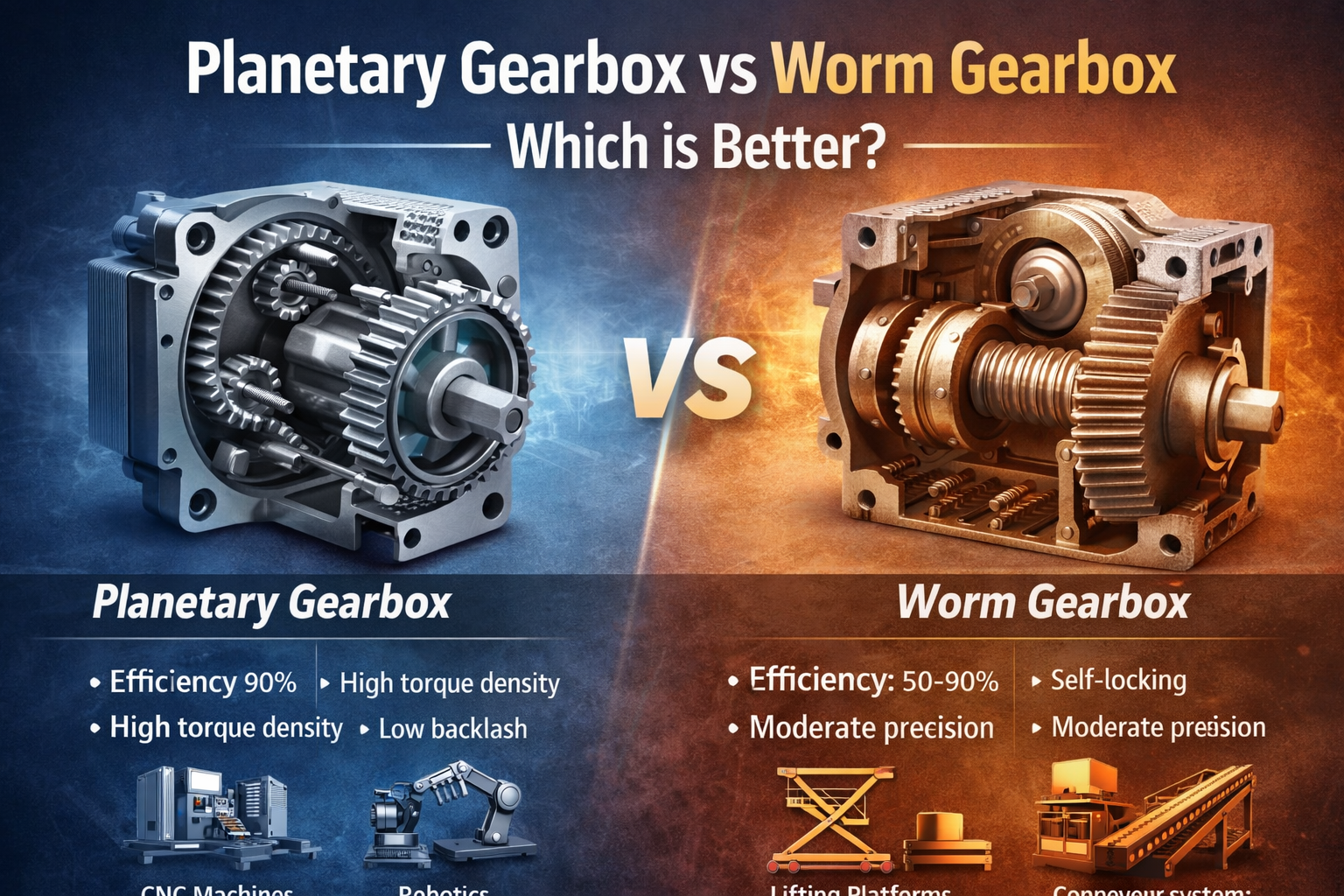
Choosing between a planetary gearbox and a worm gearbox is one of the most common engineering decisions in motion control design. Both are widely used gear reducers, but they differ significantly in efficiency, torque density, backlash performance, and mechanical lifespan.
In this technical comparison, we break down the differences in structure, performance, planetary gear ratio flexibility, and industrial application suitability.
A planetary gearbox consists of a sun gear, multiple planet gears, and an internal ring gear. The load is distributed across multiple gear teeth, providing high torque density and compact size.
A worm gearbox uses a worm screw meshing with a worm wheel. Power transmission occurs through sliding contact rather than rolling contact, which directly impacts efficiency and heat generation.
| Feature | Planetary Gearbox | Worm Gearbox |
|---|---|---|
| Transmission Efficiency | 90% – 97% | 50% – 90% (depending on ratio) |
| Heat Generation | Low | High (due to sliding friction) |
| Energy Loss | Minimal | Significant at high ratios |
For high-efficiency systems such as CNC machines and robotics, planetary gearboxes are generally superior.
Because multiple planet gears share the load, a planetary gearbox delivers higher torque in a smaller footprint compared to a worm gearbox.
Worm gearboxes are suitable for moderate torque applications but require larger housing size for equivalent torque output.
Planetary gearboxes can be designed with low backlash (≤10 arcmin), making them ideal for positioning systems and servo applications.
Worm gearboxes typically have higher backlash and are not ideal for high-precision indexing or synchronized motion control.
A key advantage of planetary gearboxes is modular planetary gear ratio configuration. Single-stage and multi-stage combinations allow ratios such as:
Worm gearboxes often offer higher single-stage ratios but with reduced efficiency.
One advantage of worm gearboxes is natural self-locking at certain ratios, which prevents back-driving.
Planetary gearboxes do not provide self-locking and may require a brake system in vertical load applications.
| Application | Recommended Gearbox |
|---|---|
| CNC Machines | Planetary Gearbox |
| Robotics | Planetary Gearbox |
| Conveyor Systems | Both |
| Lifting Platforms | Worm Gearbox (self-locking advantage) |
| Precision Indexing | Planetary Gearbox |
Choose a planetary gearbox if you require:
Choose a worm gearbox if you require:
For detailed structural explanation and ratio calculation methods, see our complete guide: Planetary Gearbox Technical Guide .