Our Location
1103A Tianhui Building, Yeqin 1st Road, Longcheng Street, Shenzhen, Guangdong, China
1103A Tianhui Building, Yeqin 1st Road, Longcheng Street, Shenzhen, Guangdong, China
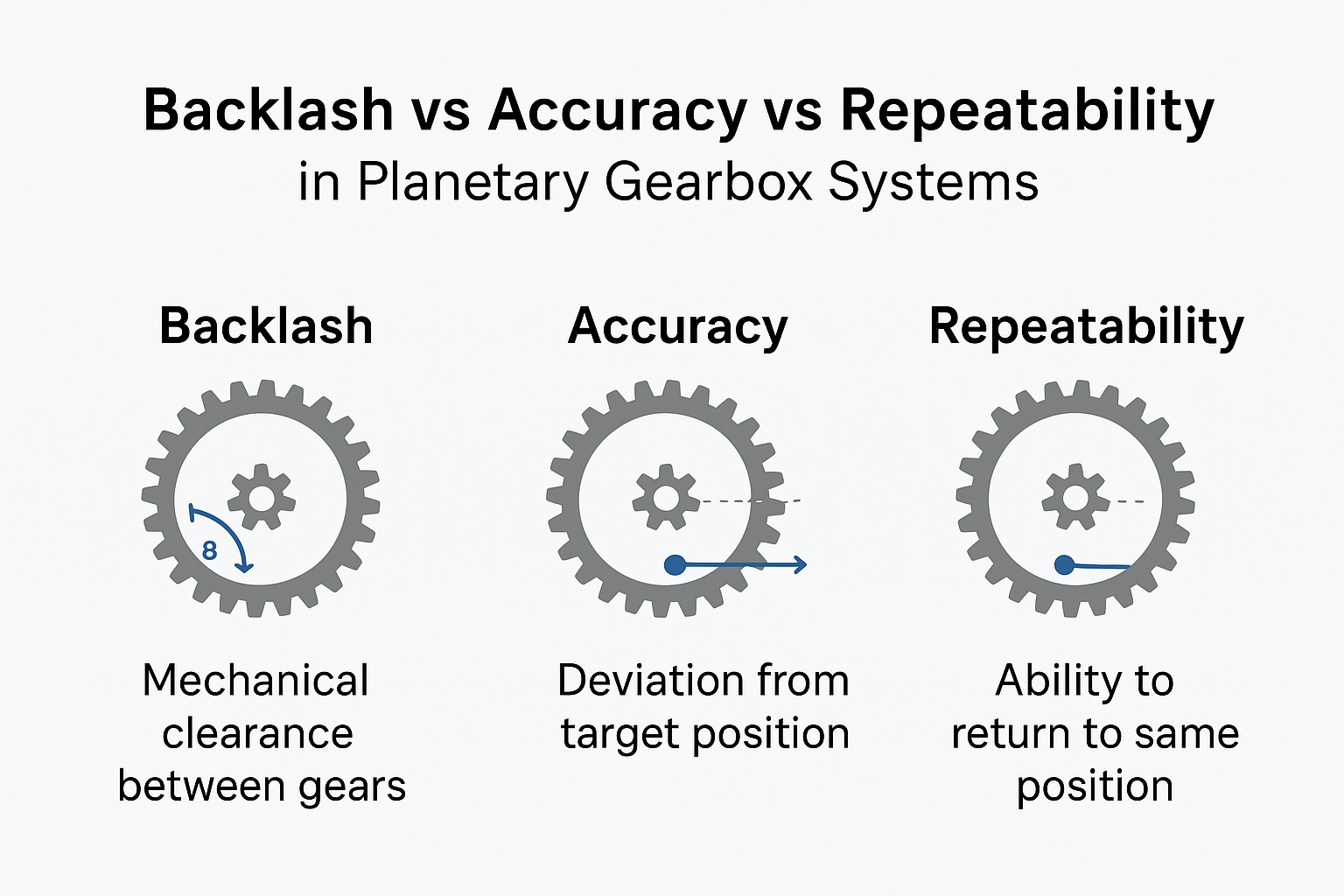
In motion control systems, terms like backlash, accuracy, and repeatability are often used interchangeably — but from an engineering perspective, they describe very different performance characteristics. This article explains how these three concepts differ, how they interact in planetary gearboxes, and how they influence real-world positioning systems.
Backlash is the angular or linear free movement between mating gear teeth when the direction of rotation is reversed. In a planetary gearbox, backlash originates from gear tooth clearance, bearing tolerances, and assembly precision.
Even high-quality planetary gearboxes require a controlled amount of backlash to ensure lubrication, thermal expansion, and long-term reliability.
Learn more about planetary gearboxes with low backlash
Backlash directly impacts positioning accuracy when direction changes occur. During reversal, the output shaft moves through the backlash angle before torque is transmitted, creating a dead zone in motion.
This effect is most noticeable in point-to-point positioning systems, CNC axes, and robotics where frequent direction changes occur.
Backlash is commonly measured using a dial indicator or encoder by rotating the input shaft clockwise and counterclockwise under no-load conditions.
| Measurement Method | Description |
|---|---|
| Dial indicator | Measures output shaft movement during reversal |
| Encoder feedback | Detects angular displacement electronically |
| Calculated backlash | Backlash angle × gear ratio |
Acceptable backlash depends heavily on the application:
No. Backlash is a mechanical clearance, while accuracy describes how close the output position is to the commanded target.
A system may have low backlash but still poor accuracy due to motor resolution, encoder errors, or control algorithm limitations.
Accuracy refers to the absolute difference between the commanded position and the actual achieved position. It is influenced by backlash, encoder resolution, gear ratio, motor step angle, and system calibration.
Accuracy measures correctness. Repeatability measures consistency.
A system can repeatedly return to the same position (high repeatability) even if that position is offset from the true target (low accuracy).
Yes. This is common in stepper motor systems with planetary gearboxes. As long as backlash is consistent and unidirectional motion is used, repeatability remains high.
Yes. Gear ratio influences how backlash is reflected at the output. Higher ratios typically reduce output backlash angle but may introduce cumulative tolerances in multi-stage gear trains.
For example, 5:1 and 10:1 planetary gearboxes are often chosen for positioning applications, while 20:1 and 50:1 ratios are favored for torque amplification with controlled motion.
In stepper motor systems, backlash can reduce effective microstepping resolution during direction changes. This is why many precision systems combine planetary gearboxes with encoders to compensate for mechanical clearance.
Industrial automation often prioritizes repeatability over absolute accuracy because processes depend on consistent motion rather than perfect positioning.
Repeatable systems allow software compensation, while inconsistent backlash behavior cannot be easily corrected.
When selecting a planetary gearbox, engineers should evaluate backlash requirements, acceptable accuracy tolerance, and the level of repeatability demanded by the application.
Understanding these differences ensures reliable system performance and avoids over-specifying components.