Our Location
1103A Tianhui Building, Yeqin 1st Road, Longcheng Street, Shenzhen, Guangdong, China
1103A Tianhui Building, Yeqin 1st Road, Longcheng Street, Shenzhen, Guangdong, China
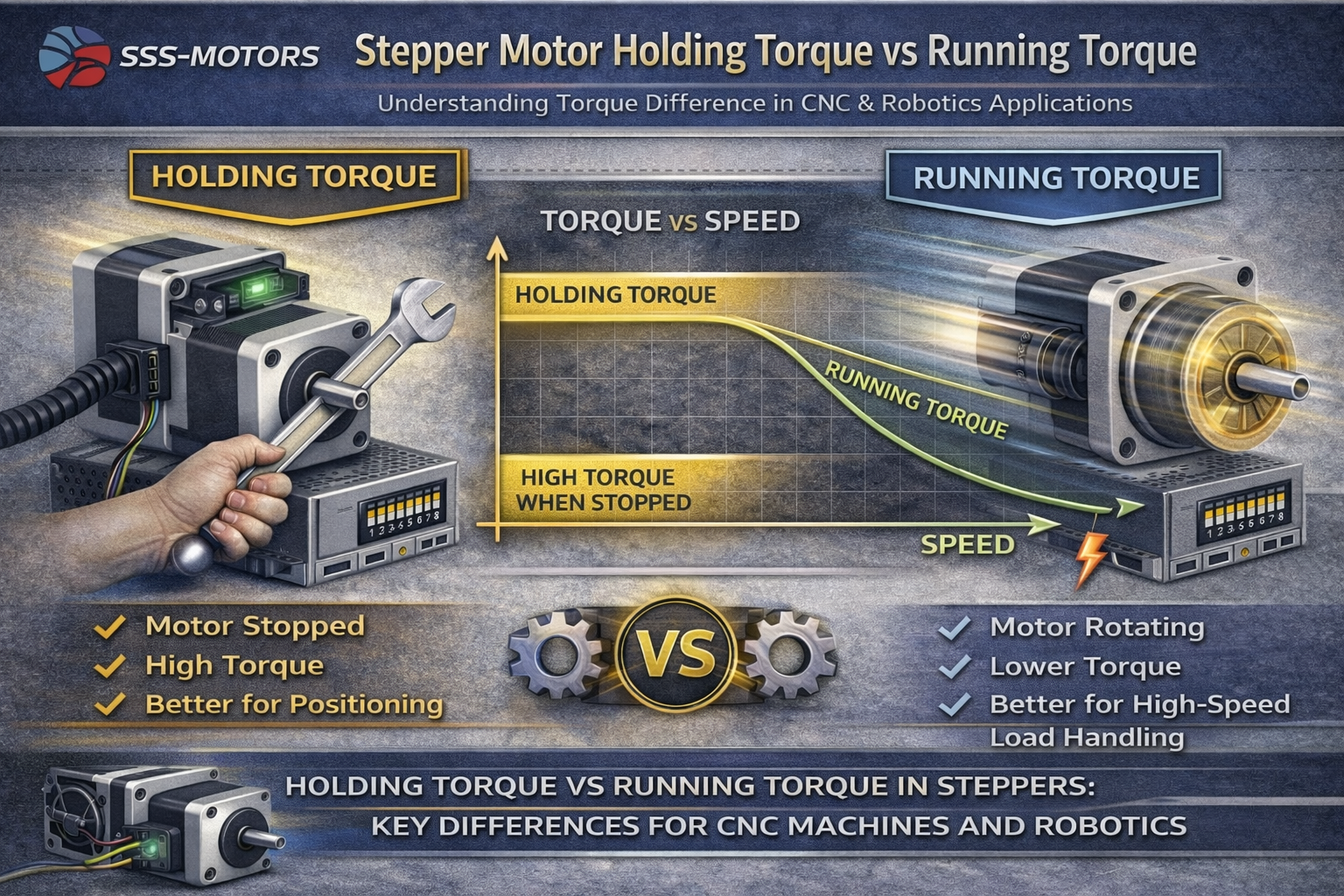
When selecting a stepper motor for your application, it is crucial to understand the concepts of holding torque and running torque.
These two parameters define the motor’s ability to hold a position and maintain movement, respectively.
In this guide, we will explain the differences between holding torque and running torque, and how they impact motor performance in CNC machines, robotics, and automation systems.
Holding torque refers to the maximum amount of torque a stepper motor can generate when it is stationary and holding a position.
It is the force required to prevent the motor shaft from moving when the motor is not rotating. Holding torque is essential in applications where the motor must maintain a fixed position, such as in CNC machines, robotics, and automation systems.
For more information on how to choose the right motor, read our
Stepper Motor Torque Explained guide.
Running torque is the amount of torque a stepper motor can produce while rotating at a given speed. Unlike holding torque, running torque is measured when the motor is actively moving and must overcome load forces. Running torque is typically lower than holding torque because the motor’s windings are energized differently while rotating.
Understanding the relationship between holding and running torque is key to selecting the right motor for your application. Check our guide on
Closed Loop Stepper Motor Advantages to learn how closed loop systems optimize torque performance.
| Feature | Holding Torque | Running Torque |
|---|---|---|
| Torque Output | Maximum torque when stationary | Lower torque during motion |
| Motor Movement | No movement (holding position) | Motor shaft rotates |
| Use Case | Positioning, holding fixed positions | Overcoming load during movement |
| Typical Applications | CNC, robotics, precision positioning | High-speed systems, load handling |
When selecting a stepper motor, it’s crucial to consider both holding and running torque to ensure the motor meets your specific application needs.
If your application requires the motor to hold a position precisely, then holding torque becomes more important.
However, if the motor needs to handle high-speed motion or carry significant loads, running torque will be the key factor.
If you need assistance with motor selection, feel free to explore our full range of products in the
Stepper Motor Products category.
Holding torque is generally higher because the motor is not rotating, allowing all coils to generate maximum force. In running conditions, the current to the coils is dynamically controlled to allow for rotation, reducing available torque.
Running torque determines the motor’s ability to overcome load forces while moving. In high-speed applications, ensuring the motor has sufficient running torque is essential for smooth, consistent operation.
Yes, closed-loop stepper motors use feedback to optimize torque, improving both holding and running torque, especially in demanding applications. Learn more in our
Closed Loop Stepper Motor Advantages article.
If you’re unsure which stepper motor is right for your application, SSS-Motors engineers can assist with motor selection, torque calculations, and system configuration.
We’ll ensure that your system runs efficiently and reliably.


[…] Stepper Motor Holding Torque vs Running Torque Explained – Understand how torque characteristics influence positioning accuracy and load performance. […]
[…] Stepper Motor Holding Torque vs Running Torque Explained – Understand how torque characteristics influence positioning accuracy and load performance. […]
[…] Stepper Motor Holding Torque vs Running Torque Explained – Understand how torque characteristics influence positioning accuracy and load performance. […]