Our Location
1103A Tianhui Building, Yeqin 1st Road, Longcheng Street, Shenzhen, Guangdong, China
1103A Tianhui Building, Yeqin 1st Road, Longcheng Street, Shenzhen, Guangdong, China
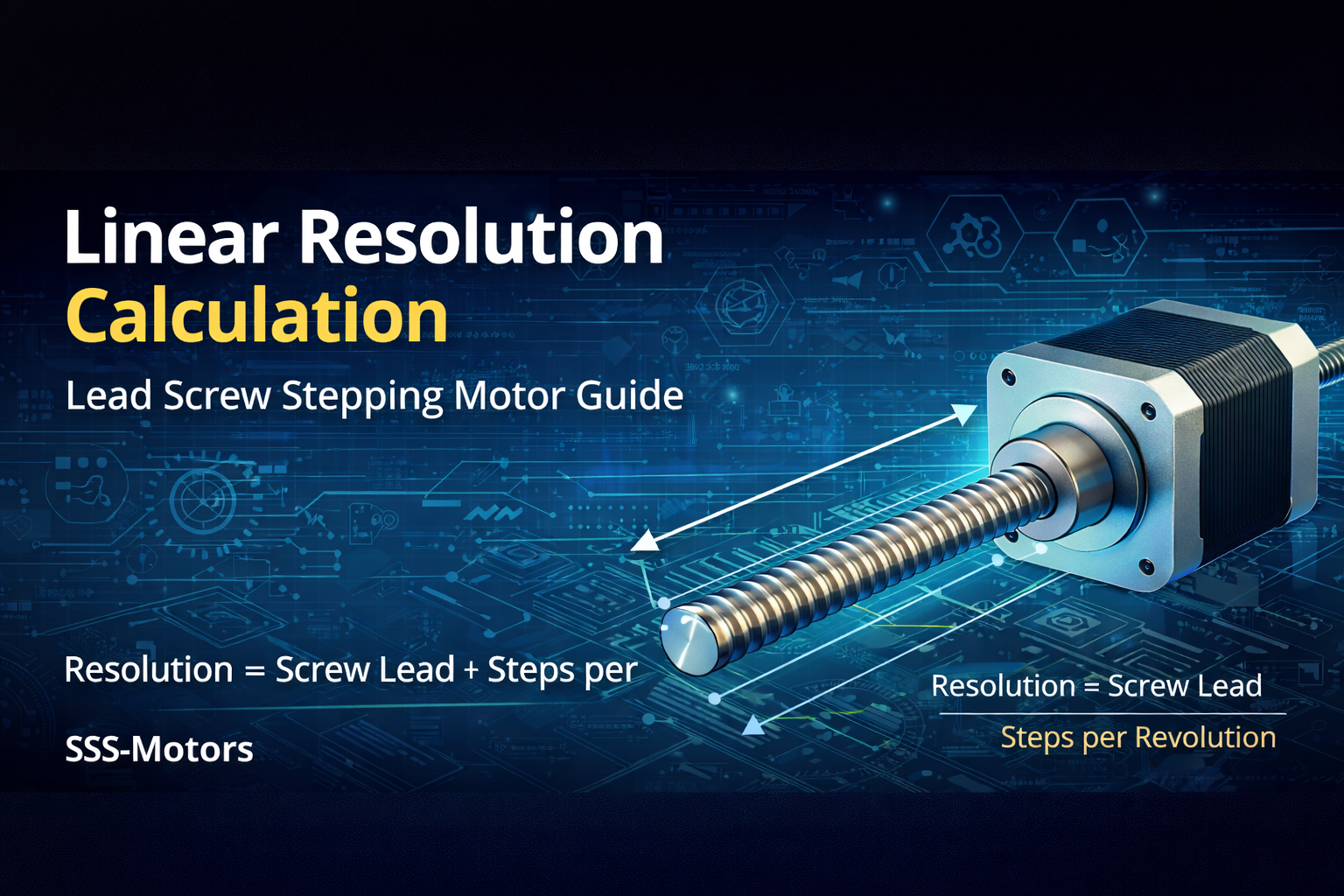
Linear resolution plays a critical role in precision motion control.
Therefore, engineers who design stepper motor driven linear systems must understand how linear resolution affects positioning accuracy and repeatability.
In automation equipment and adjustment mechanisms, linear resolution directly influences system performance.
As a result, designers should evaluate resolution early in the mechanical and electrical design process.
Linear resolution describes the smallest linear movement a system produces from a single motor step.
In practice, this parameter defines how precisely a linear resolution stepper motor positions a load.
According to
Wikipedia’s stepper motor definition
,
stepper motors move in discrete steps.
Therefore, engineers can calculate linear resolution directly from mechanical parameters.
Several design parameters influence linear resolution in stepper motor driven linear actuators.
Most importantly, motor step angle, screw lead, and driver configuration determine the final resolution.
Among these parameters, screw lead has the strongest impact.
Consequently, designers often adjust screw specifications to balance speed and precision.
Engineers typically calculate linear resolution using a simple mechanical formula:
Linear Resolution = Screw Lead ÷ Steps per Revolution
For example, a stepper motor with a 1.8° step angle completes 200 full steps per revolution.
When engineers pair this motor with a T8×4 lead screw, the calculation becomes:
4 mm ÷ 200 = 0.020 mm per step
This result shows the linear displacement generated by one full motor step.
Therefore, designers can immediately estimate positioning capability.
Microstepping further improves linear resolution by dividing each full step into smaller increments.
As a result, the motor produces smoother motion and finer positioning.
For instance, when a driver operates at 16 microsteps per full step, the effective resolution becomes:
0.020 mm ÷ 16 = 0.00125 mm per microstep
According to
Wikipedia’s microstepping explanation
,
microstepping primarily improves smoothness.
However, engineers should remember that microstep resolution does not always equal absolute accuracy.
In practice, engineers often combine stepper motors with lead screw mechanisms to create compact screw actuators.
This design approach simplifies installation while maintaining reliable linear motion.
For example, a
NEMA 17 stepper motor with lead screw
delivers an effective balance between resolution, thrust, and system size.
Therefore, designers frequently use this configuration in laboratory instruments, adjustment platforms, and compact actuador linear systems.
When engineers design high-precision linear systems, they should evaluate linear resolution together with load, speed, and mechanical rigidity.
Moreover, they should avoid relying on resolution values alone.
By selecting appropriate motor specifications, screw parameters, and driver settings,
designers can build stepper motor based linear actuators that deliver stable and repeatable performance in automation environments.
To further explore stepper motor design and linear motion principles,
you may find the following related articles helpful: