Our Location
1103A Tianhui Building, Yeqin 1st Road, Longcheng Street, Shenzhen, Guangdong, China
1103A Tianhui Building, Yeqin 1st Road, Longcheng Street, Shenzhen, Guangdong, China
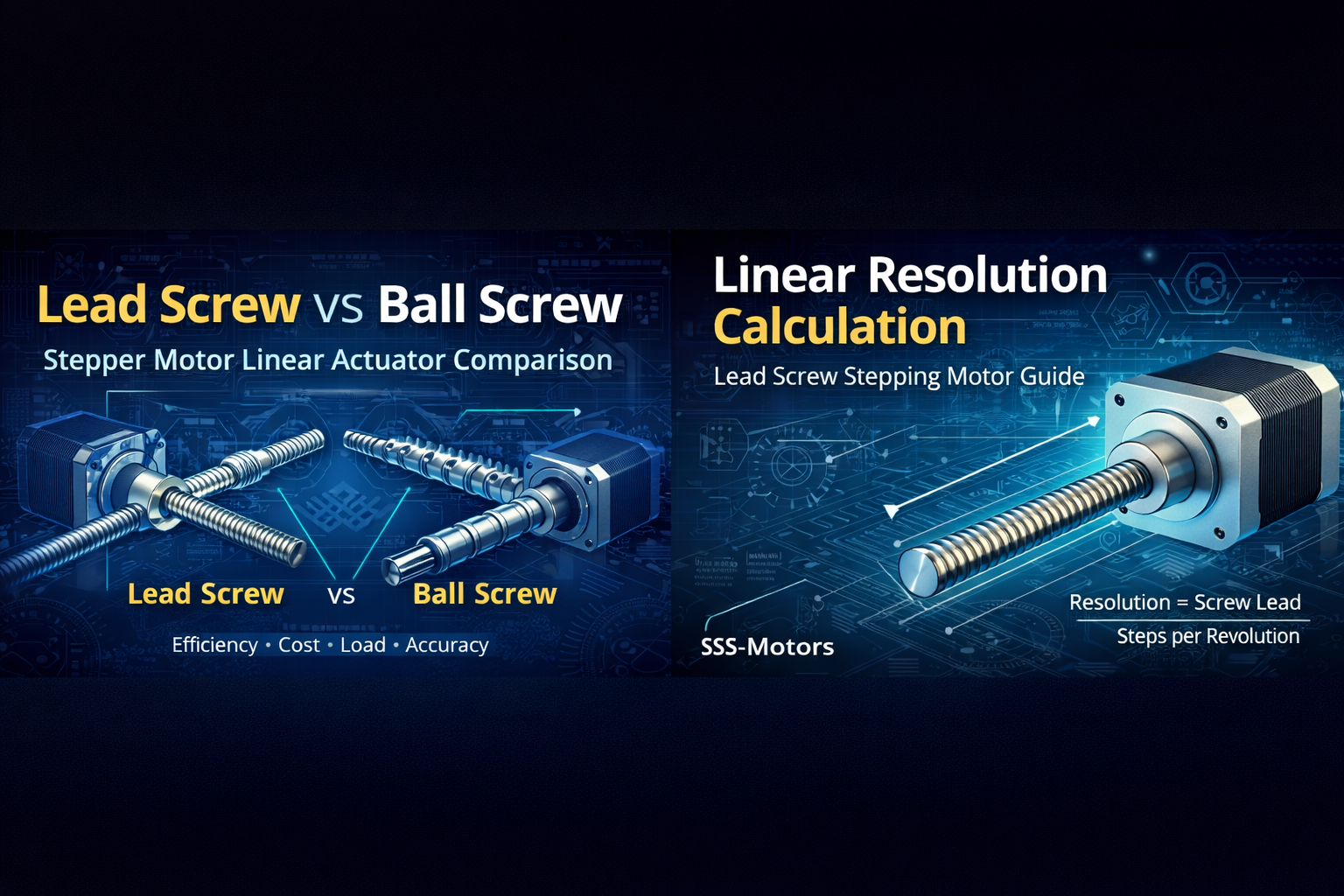
When selecting a stepper motor linear actuator, engineers often compare lead screw and ball screw solutions.
Therefore, understanding their differences is essential for choosing the right linear drive motor
for automation and precision motion systems.
A lead screw stepper motor converts rotary motion into linear movement using a trapezoidal or ACME screw.
As a result, it offers a simple and cost-effective screw actuator solution with good positioning accuracy.
According to
Wikipedia’s lead screw overview
,
lead screws are widely used in mechanical systems where durability and simplicity are required.
In contrast, a ball screw stepper motor uses recirculating balls to reduce friction between the screw and nut.
Consequently, efficiency and load capacity are significantly improved.
Ball screw mechanisms are in precision motion guides, as explained by
Wikipedia’s ball screw explanation
.
In most compact automation systems, a lead screw stepping motor provides sufficient accuracy and stability.
Therefore, it is widely used in laboratory equipment, medical devices, and adjustment mechanisms.
For example, a
NEMA 17 lead screw stepping motor
offers an excellent balance between cost, size, and performance.
On the other hand, ball screw stepper motors are more suitable for high-speed or heavy-load applications.
By comparing system requirements carefully, engineers can select the most appropriate stepper motor linear actuator.
To further explore stepper motor design and linear motion principles, you may find the following related articles helpful: