Our Location
1103A Tianhui Building, Yeqin 1st Road, Longcheng Street, Shenzhen, Guangdong, China
1103A Tianhui Building, Yeqin 1st Road, Longcheng Street, Shenzhen, Guangdong, China
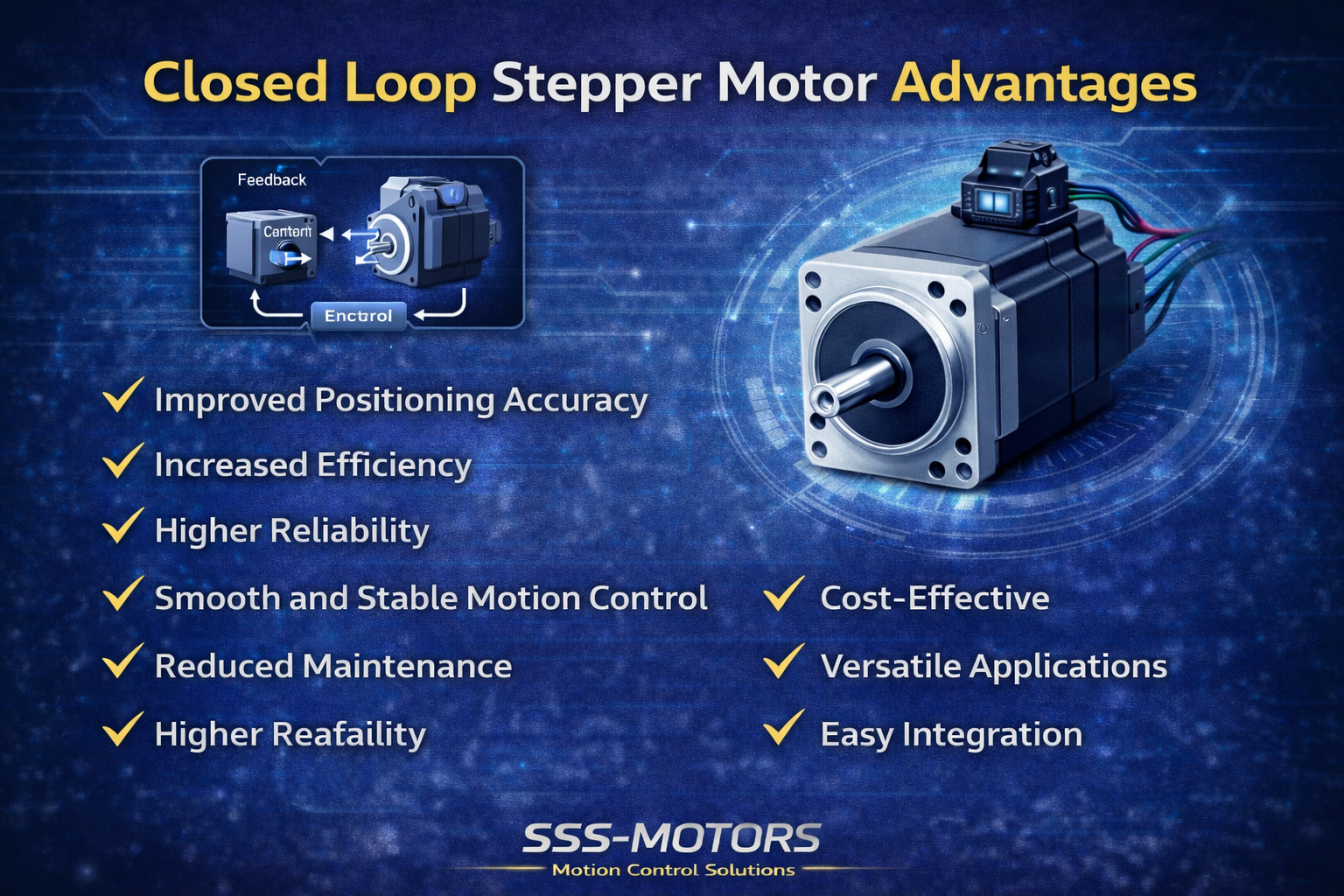
Closed loop stepper motors offer significant advantages over open loop systems
by providing real-time position feedback via encoders. This feedback allows for
dynamic correction of position errors, which results in increased performance, efficiency, and reliability.
In this article, we will explore the key advantages of closed loop stepper motors and explain why
they are the preferred choice for many industrial and automation applications.
If you’re considering upgrading your motion control system, you may also find it helpful to read
How to Choose a Stepper Motor
and
Closed Loop vs Open Loop Stepper Motor
for more in-depth guidance.
One of the primary advantages of closed loop stepper motors is their ability to continuously monitor and adjust their position through feedback systems, such as encoders. This real-time monitoring ensures precise and accurate positioning even under varying loads or high-speed conditions. Therefore, compared to open loop systems, closed loop stepper motors provide a far higher level of precision and consistency.
Another key benefit is that closed loop stepper motors can dynamically adjust their current based on real-time feedback. As a result, they minimize energy consumption and reduce heat generation. Consequently, this not only improves the system’s overall efficiency but also helps extend the motor’s lifespan. Therefore, closed loop stepper motors are a more energy-efficient solution compared to open loop alternatives, which constantly draw current regardless of load conditions.
Closed loop stepper motors offer higher reliability because the system can automatically correct any deviation from the commanded position. This feedback mechanism ensures stable performance under load, preventing step loss and reducing downtime. In contrast, open loop systems are more prone to losing steps, especially when subjected to heavy load or rapid acceleration, which makes them less reliable in critical applications. Therefore, closed loop systems provide a much more stable and consistent solution for demanding operations.
In addition, closed loop stepper motors provide smoother motion and better velocity control compared to open loop systems. This makes them ideal for applications that require precise, steady motion, such as CNC machines, robotics, and 3D printing. As a result, these motors ensure more consistent and accurate performance, which is essential for tasks requiring high levels of detail and precision.
Since closed loop stepper motors prevent issues like step loss and overheating, they require less frequent maintenance. Consequently, with better thermal management and real-time performance adjustments, the motor operates more reliably over time. This results in reduced service intervals and a longer operational lifespan. Compared to open loop motors, which are more prone to wear and inefficiency, closed loop motors offer a more cost-effective long-term solution by reducing downtime and maintenance costs.
While closed loop stepper motors typically have a higher upfront cost than open loop systems, their efficiency, reliability, and reduced maintenance needs make them a cost-effective solution for long-term, high-duty applications. Over time, the increased performance and decreased downtime can significantly lower operational costs, making closed loop systems a more economical choice in the long run. Therefore, for industries that demand continuous high performance, closed loop motors are often the best investment.
Another significant advantage is that closed loop stepper motors are versatile and can be used across a wide variety of industries and applications. They are widely used in:
Closed loop stepper motors are also easy to integrate with most industrial control systems, such as PLCs, microcontrollers, and CNC controllers. With minimal setup and tuning required, they can be quickly added to existing systems, improving performance without the need for extensive modifications. As a result, closed loop stepper motors provide a simple yet effective solution for upgrading older systems or enhancing new ones.
In summary, closed loop stepper motors provide significant advantages in terms of accuracy, efficiency, reliability, and cost-effectiveness for many industrial and automation applications. If you’re looking for a solution that offers better performance, smoother motion, and less downtime, a closed loop stepper motor is the ideal choice. So, if you’re ready to experience the benefits of closed loop technology, browse our range of products and get in touch with us for expert guidance on selecting the right motor for your system.
You can explore our available models in the
Stepper Motor product category,
or contact us for technical support or more information.
After learning about the advantages of closed loop stepper motors,
you can explore the differences between closed loop and open loop systems
to decide which motor technology is right for your application:
Closed Loop vs Open Loop Stepper Motor.