Our Location
1103A Tianhui Building, Yeqin 1st Road, Longcheng Street, Shenzhen, Guangdong, China
1103A Tianhui Building, Yeqin 1st Road, Longcheng Street, Shenzhen, Guangdong, China
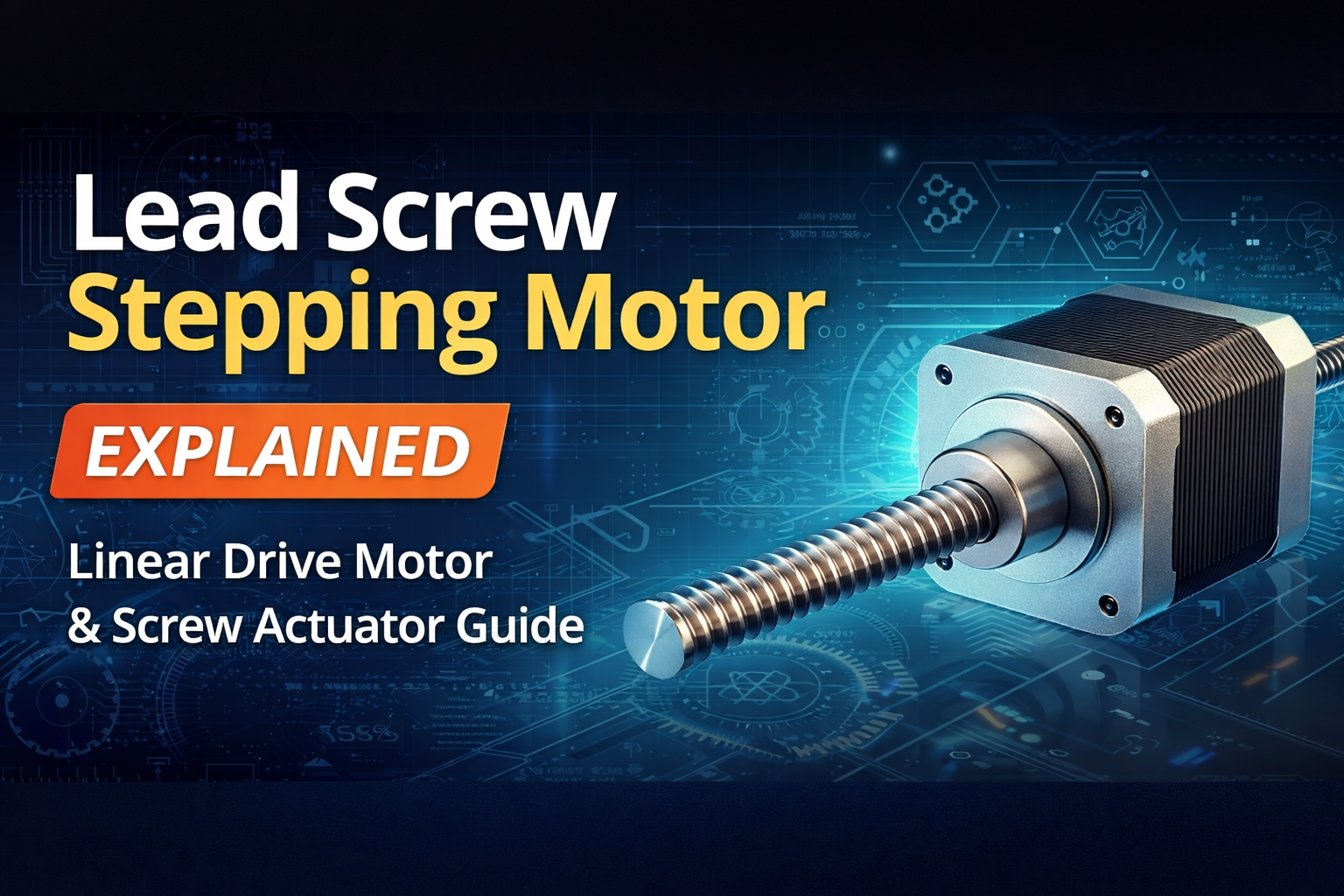
A lead screw stepping motor is one of the most widely used solutions for converting rotary motion into accurate linear movement.
As a result, it plays a critical role in modern automation and precision motion systems.
By combining the positioning advantages of a stepper motor with the mechanical efficiency of a screw actuator,
this type of motor delivers reliable linear motion in a compact structure.
In simple terms, a lead screw stepping motor is a type of stepper motor linear actuator that integrates a stepper motor with a threaded lead screw.
When the motor rotates, the lead screw converts controlled rotary steps into precise linear displacement.
Therefore, accurate positioning can be achieved without complex feedback systems.
According to
Wikipedia’s definition of stepper motors
,
stepper motors move in discrete steps, making them especially suitable for positioning tasks.
As a result, combining a stepper motor with a lead screw naturally forms a precise linear drive motor.
In a typical screw actuator design, the rotating lead screw engages with a nut to generate linear motion.
As the screw turns, linear movement is produced at a rate defined by the screw lead.
Consequently, both speed and resolution can be precisely controlled through motor selection.
For example, a NEMA 17 lead screw stepping motor using a T8×4 trapezoidal screw provides a 4 mm linear travel per revolution.
This means that engineers can achieve an effective balance between speed and precision in
actuador linear applications.
From a mechanical perspective, trapezoidal screws are widely used in industrial motion systems due to their durability.
This principle is also explained in
Wikipedia’s lead screw overview
,
which highlights their role in converting rotational motion into linear displacement.
There are several reasons why lead screw stepping motors are preferred in linear motion systems.
First, they offer high positioning accuracy without requiring external encoders.
Second, they provide stable thrust and smooth linear movement.
Moreover, their compact structure makes them suitable for installations with limited space.
As a result, lead screw stepping motors are widely used in applications that require controlled linear motion
with minimal mechanical complexity.
Among various frame sizes, the NEMA 17 lead screw stepping motor is especially popular.
This is because it offers an excellent balance between torque, size, and cost.
Therefore, it is commonly used in laboratory instruments, medical devices, and compact automation modules.
A typical example is a
NEMA 17 lead screw stepping motor with T8×4 screw
,
which provides a standard 300 mm travel while allowing customized screw lengths.
As a result, this type of stepper motor linear actuator is suitable for both OEM integration
and custom automation projects.
The linear resolution of a lead screw stepping motor depends primarily on the motor step angle and the screw lead.
For instance, with a 1.8° step angle motor and a T8×4 lead screw,
the full-step resolution is 0.020 mm per step.
However, by using microstepping drivers, the resolution can be further improved.
Consequently, the motor becomes suitable for high-precision
linear drive motor tasks in measurement and positioning systems.
Because of their accuracy and reliability, lead screw stepping motors are widely used in automation and motion control systems.
In particular, common applications include the following:
Therefore, in applications where precise linear motion is required,
lead screw stepping motors offer a practical and cost-effective solution.
When selecting a lead screw stepping motor, several factors should be considered.
These include screw type, travel length, required thrust, and driver compatibility.
For applications that demand flexibility, a motor with customizable screw length is often preferred.
For this reason, a
NEMA 17 lead screw stepping motor
is an excellent choice for many automation systems.
By understanding the working principle and advantages of screw actuators,
engineers can select the right stepper motor linear actuator to improve system accuracy and long-term reliability.
To further explore stepper motor design and linear motion principles,
you may find the following related articles helpful:


[…] Stepper Motor Linear Actuator Design Guide – Learn how engineers combine motors and lead screws to build compact linear motion systems. […]