Our Location
1103A Tianhui Building, Yeqin 1st Road, Longcheng Street, Shenzhen, Guangdong, China
1103A Tianhui Building, Yeqin 1st Road, Longcheng Street, Shenzhen, Guangdong, China
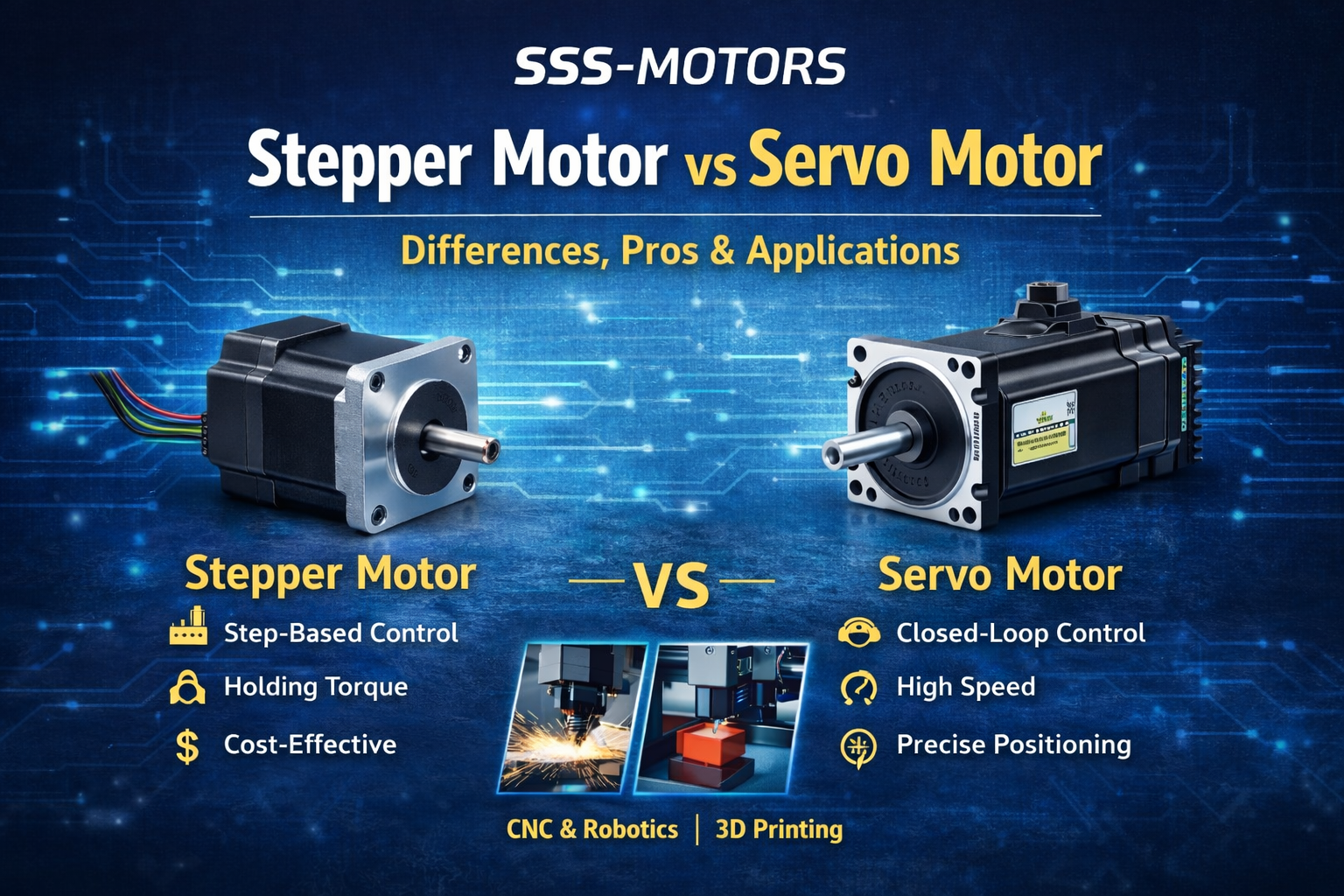
Stepper motors and servo motors are two of the most commonly used motors
in motion control and automation systems.
While both are designed to provide precise control, they operate on
different principles and are suited to different applications.
If you are new to stepper motors, you may first read
What Is a Stepper Motor
and
How Does a Stepper Motor Work
to understand the basics.
You can also explore our
Stepper Motor solutions
for CNC, robotics, and industrial automation applications.
The fundamental difference between a stepper motor and a servo motor
lies in how motion is controlled.
Stepper motors typically operate in open-loop control,
while servo motors always rely on feedback devices such as encoders
to maintain accurate position and speed.
Stepper motors are controlled by pulse signals sent from a driver.
Each pulse corresponds to a fixed step angle, allowing accurate positioning
without feedback in many applications.
Servo motors use a closed-loop control system.
An encoder continuously feeds position information back to the controller,
which adjusts the motor output to correct any deviation.
Stepper motors provide high holding torque at low speeds,
making them ideal for positioning and indexing applications.
However, torque decreases as speed increases.
Servo motors deliver consistent torque across a wide speed range
and perform well in high-speed and high-dynamic applications.
Stepper motors achieve positioning accuracy through precise step angles,
such as 1.8° or 0.9°. In properly sized systems, they offer reliable
repeatability without feedback.
Servo motors rely on feedback to achieve very high accuracy and
dynamic response, even under varying loads.
Stepper motor systems are generally simpler and more cost-effective.
They require less complex controllers and tuning compared to servo systems.
Servo motor systems are more expensive due to the need for encoders,
advanced drives, and tuning procedures.
| Feature | Stepper Motor | Servo Motor |
|---|---|---|
| Control Type | Open-loop or closed loop | Closed-loop |
| Positioning | Step-based positioning | Continuous feedback control |
| Holding Torque | High at standstill | Requires brake or current |
| Speed Range | Low to medium | Wide and high-speed |
| System Cost | Lower | Higher |
| System Complexity | Simple | Complex |
The choice between a stepper motor and a servo motor depends on your
application requirements.
For many automation and CNC applications, closed loop stepper motors
offer a practical balance between performance and cost.
You can explore available options in our
Stepper Motor product category
to find suitable configurations for your system.
If you are planning to select a stepper motor for your application,
this step-by-step guide explains the key factors you should consider:
How to Choose a Stepper Motor
.
If you are selecting motors for CNC machines or automation systems, you may also compare stepper motors with other common motion control solutions:
Understanding these differences helps engineers select the correct motor technology based on speed requirements, positioning accuracy, and system complexity.
Stepper motors move in discrete steps without requiring feedback, while servo motors use encoder feedback for continuous closed-loop motion control.
Servo motors typically provide higher dynamic accuracy, especially at high speeds and under changing load conditions.
Yes, stepper motors are generally more cost-effective and easier to control compared to servo motor systems.
Stepper motors are ideal for applications requiring simple positioning control, moderate speed, and lower system cost.
Yes, servo motors rely on encoder feedback to monitor position and speed for precise motion control.
Stepper motors can replace servo motors in low to medium performance positioning applications where ultra-high speed and torque are not required.


[…] Stepper Motor vs Servo Motor: Accuracy, Speed and Cost Comparison Guide […]
[…] Stepper Motor vs Servo Motor: Performance, Cost and Application Comparison […]
[…] stepper motor vs servo motor for CNC positioning systems […]