Our Location
1103A Tianhui Building, Yeqin 1st Road, Longcheng Street, Shenzhen, Guangdong, China
1103A Tianhui Building, Yeqin 1st Road, Longcheng Street, Shenzhen, Guangdong, China
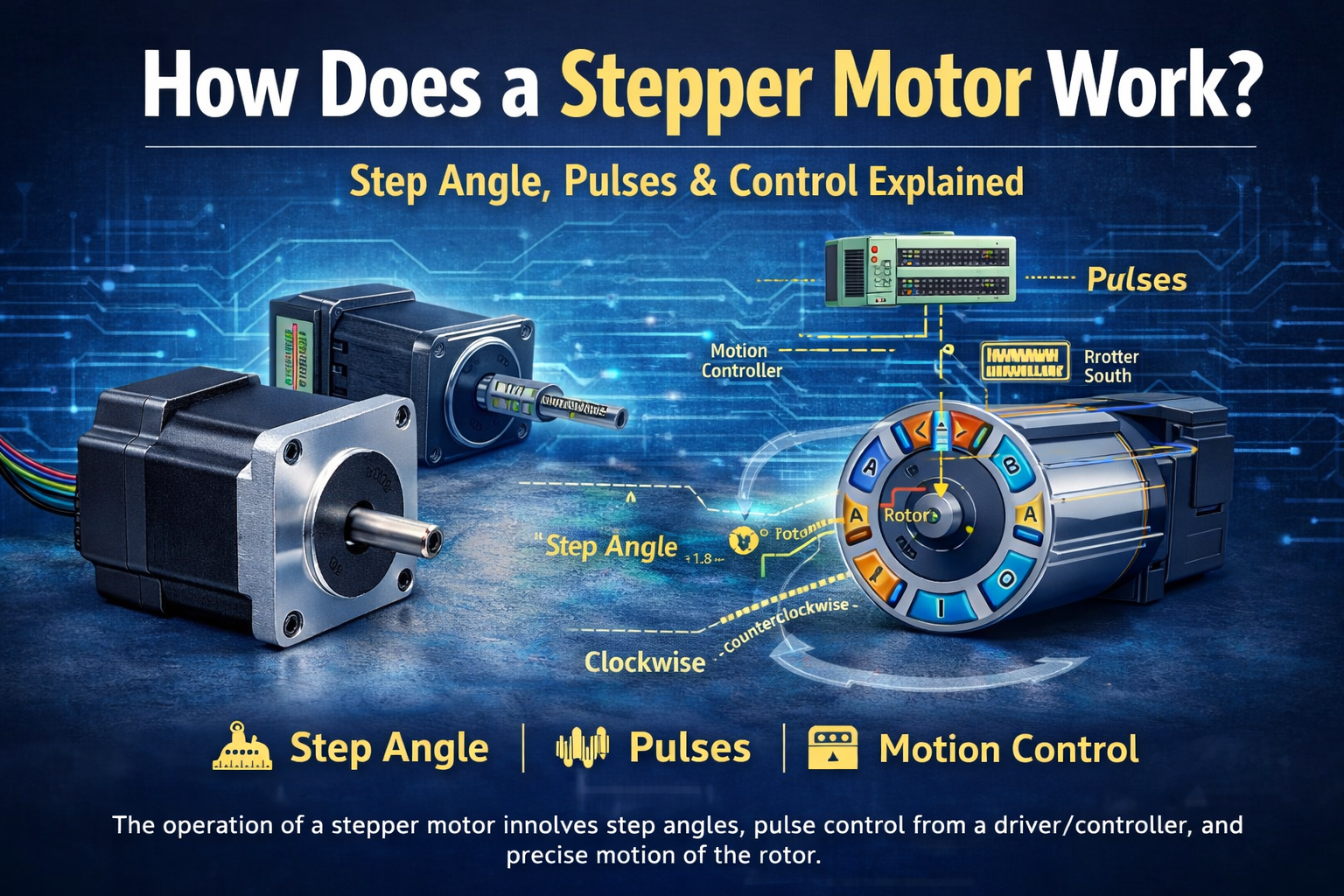
A stepper motor works by converting electrical pulse signals into precise
mechanical movement. Each pulse sent from the controller causes the motor
shaft to rotate by a fixed angle, allowing accurate position and speed control
without the need for feedback in many applications.
If you are new to stepper motors, you may also find it helpful to read
What Is a Stepper Motor
for a basic definition and overview.
For industrial applications and product options, you can explore our
Stepper Motor solutions
designed for CNC, robotics, and automation systems.
Inside a stepper motor, the stator contains multiple electromagnetic coils,
while the rotor is made of permanent magnets or soft iron teeth.
When the controller energizes the coils in a specific sequence,
magnetic fields are created that pull the rotor to a precise position.
Each time the magnetic field shifts, the rotor moves by one step.
By continuously changing the energized coils, the motor rotates step by step
in a controlled and repeatable manner.
The step angle is the angular distance the motor shaft moves for each input pulse.
Common step angles include 1.8° and 0.9°.
For example, a stepper motor with a 1.8° step angle requires
200 pulses to complete one full revolution
(360° ÷ 1.8° = 200 steps).
In a stepper motor system, motion is controlled by pulse signals sent from
a driver or motion controller.
This pulse-based control makes stepper motors especially suitable for digital
control systems such as PLCs, microcontrollers, and CNC controllers.
In full-step mode, the motor moves one full step for each pulse.
This mode provides maximum torque but may produce more vibration.
Half-step mode alternates between single and dual coil excitation,
effectively doubling the resolution while reducing vibration.
Microstepping divides each full step into smaller microsteps by precisely
controlling the current in each coil.
This results in smoother motion, reduced noise, and improved positioning accuracy,
especially in high-precision applications.
Most traditional stepper motor systems operate in open-loop control,
where the controller assumes the motor follows the commanded pulses.
In closed loop stepper motors, an encoder provides position feedback,
allowing the controller to correct errors, prevent step loss,
and improve efficiency.
Learn more about available configurations in our
Stepper Motor product category
including closed loop stepper motors for demanding applications.
Understanding how a stepper motor works helps engineers and system designers
select the correct motor, driver, and control method for their application.
Proper selection improves positioning accuracy, reduces vibration,
and ensures reliable long-term operation.
If you are planning to select a stepper motor for your application,
this step-by-step guide explains the key factors you should consider:
How to Choose a Stepper Motor
.