Our Location
1103A Tianhui Building, Yeqin 1st Road, Longcheng Street, Shenzhen, Guangdong, China
1103A Tianhui Building, Yeqin 1st Road, Longcheng Street, Shenzhen, Guangdong, China
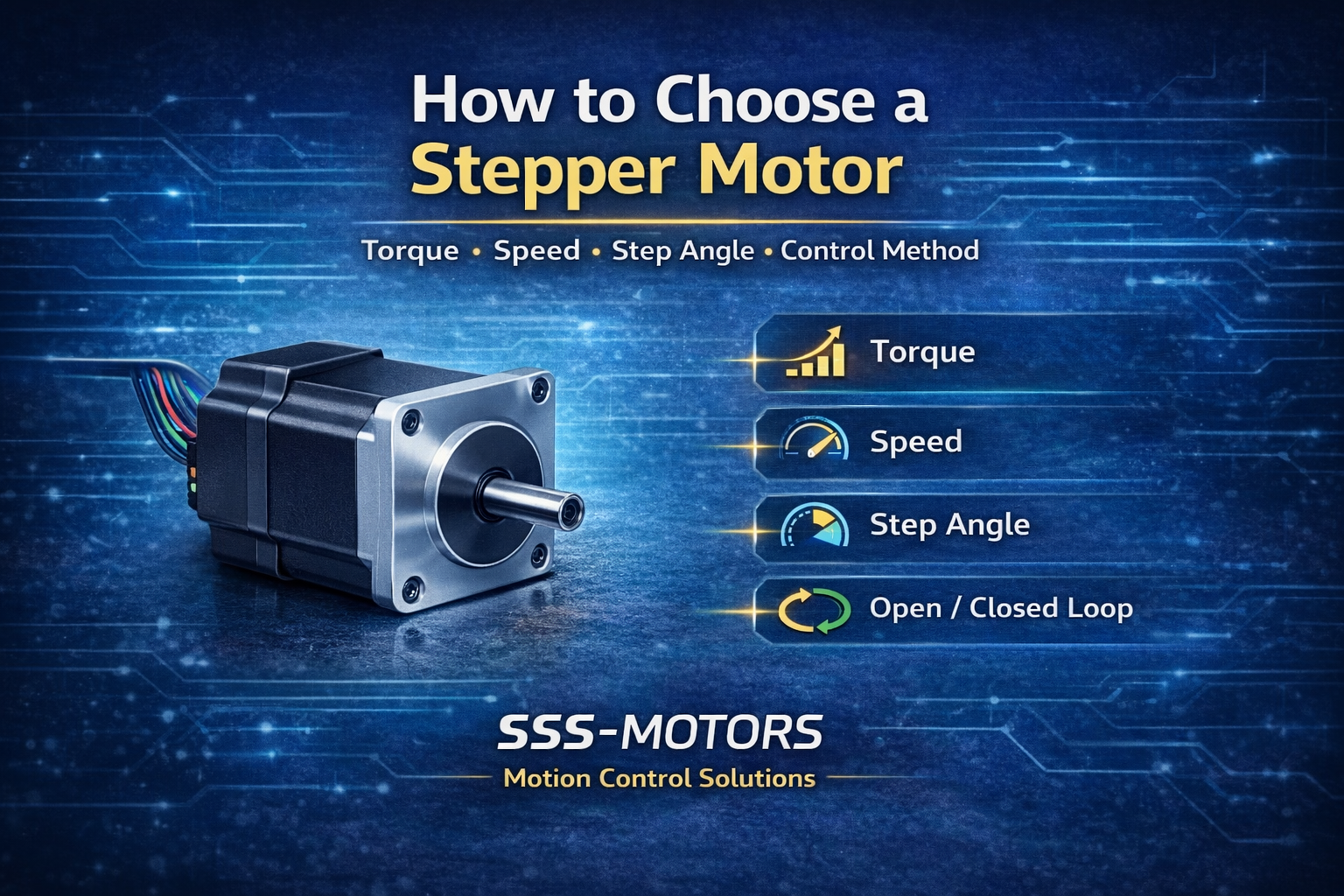
Choosing the right stepper motor is essential for achieving accurate,
reliable, and efficient motion control.
Selecting an unsuitable motor can result in step loss, overheating,
or insufficient performance.
This guide explains the key factors you should consider when choosing
a stepper motor for your application.
If you are new to stepper motors, you may first read
What Is a Stepper Motor
How Does a Stepper Motor Work
and
Advantages and Disadvantages of Stepper Motors
For industrial-grade options, you can explore our
Stepper Motor solutions
designed for automation, CNC, and robotics applications.
Torque is the most critical parameter when selecting a stepper motor.
You should calculate the required torque based on load weight,
friction, acceleration, and mechanical transmission.
Always include a safety margin when selecting torque to prevent
step loss and ensure reliable operation.
Stepper motors perform best at low to medium speeds.
As speed increases, available torque decreases.
If your application requires higher speed,
consider using a closed loop stepper motor
or selecting a motor with higher voltage and appropriate driver.
Common step angles include 1.8° and 0.9°.
A smaller step angle provides higher positioning resolution
but may reduce maximum speed.
Microstepping can further improve motion smoothness
and positioning accuracy.
Stepper motors are available in standardized frame sizes
such as NEMA 17, NEMA 23, and NEMA 34.
The frame size affects torque output, physical dimensions,
and mounting compatibility.
Open-loop stepper motors are suitable for many applications
where load conditions are stable and predictable.
Closed loop stepper motors use encoders to provide feedback,
prevent step loss, and improve efficiency,
making them ideal for demanding or variable-load applications.
Ensure the selected stepper motor is compatible with
your power supply voltage and driver current rating.
Proper matching of motor, driver, and power supply
is essential for achieving optimal performance and reliability.
Consider environmental factors such as temperature,
humidity, dust, and vibration.
For harsh environments, select motors with appropriate
protection, insulation, and mechanical design.
A properly selected stepper motor provides precise,
reliable, and cost-effective motion control.
For most automation and CNC applications,
hybrid stepper motors offer an excellent balance
between performance and cost.
You can browse available models and configurations in our
Stepper Motor product category
or contact us for assistance with motor selection.
The required torque depends on load weight, transmission mechanism, acceleration requirements, and friction. Engineers usually apply a safety factor of 1.5 to 2 times the calculated torque to ensure reliable operation.
Higher voltage improves high-speed performance of stepper motors. The recommended voltage depends on the driver specification and the speed requirements of the application.
The correct frame size is selected based on required torque, installation space, and mechanical load conditions. Common frame sizes include NEMA 17, NEMA 23, and NEMA 34.
A gearbox is recommended when higher torque output, lower operating speed, or improved positioning resolution is required in the application.
Closed-loop stepper motors are ideal for applications requiring higher reliability, reduced vibration, and prevention of missed steps during operation.
The driver should match the motor rated current, voltage range, and control interface requirements such as pulse and direction signals.