Our Location
1103A Tianhui Building, Yeqin 1st Road, Longcheng Street, Shenzhen, Guangdong, China
1103A Tianhui Building, Yeqin 1st Road, Longcheng Street, Shenzhen, Guangdong, China
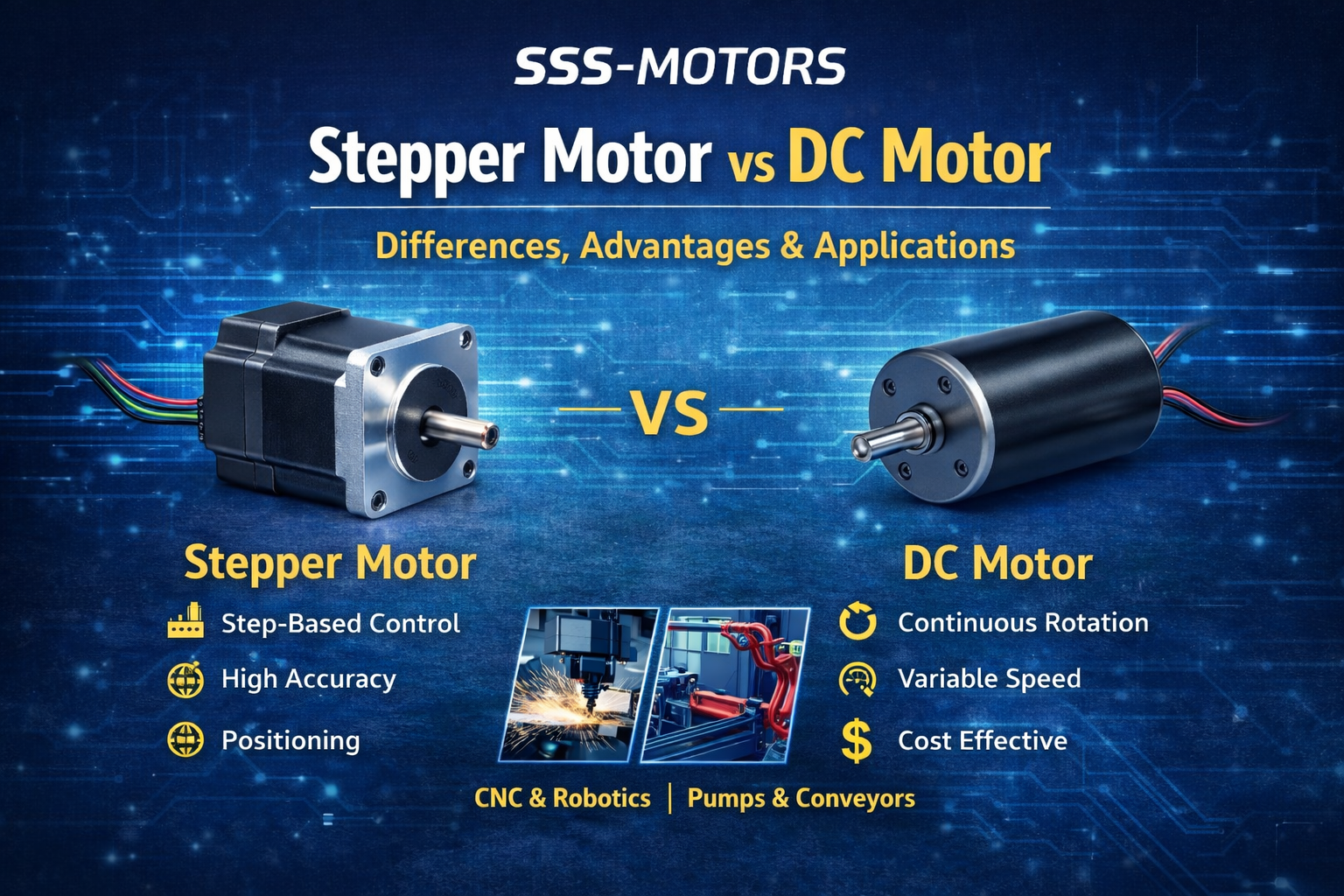
Stepper motors and DC motors are two widely used motor types in
motion control and industrial applications.
Although both convert electrical energy into mechanical motion,
they differ significantly in control method, performance,
and typical use cases.
If you are new to stepper motors, you may first read
What Is a Stepper Motor
to understand the basic concept.
For industrial automation and CNC applications, you can explore our
Stepper Motor solutions
designed for precise motion control.
The fundamental difference lies in how motion is controlled.
Stepper motors are commonly used for precise positioning,
while DC motors are often used for continuous rotation
and speed control.
Stepper motors are controlled by digital pulse signals.
Each pulse causes the motor shaft to move by a fixed step angle,
allowing accurate position control without feedback in many applications.
DC motors are typically controlled by adjusting the supply voltage
or using PWM (pulse width modulation) to regulate speed.
Additional sensors or encoders are required for precise positioning.
Stepper motors provide high holding torque at low speeds,
making them suitable for positioning and indexing tasks.
However, torque decreases as speed increases.
DC motors perform well at higher speeds and deliver smooth,
continuous rotation. Torque is generally proportional to current.
Stepper motors offer inherent positioning accuracy due to fixed step angles,
such as 1.8° or 0.9°, enabling repeatable motion without feedback.
DC motors do not provide inherent position control.
Encoders or feedback systems are required for accurate positioning.
Stepper motor systems are relatively simple and cost-effective
for precise positioning applications.
They require stepper drivers but minimal system tuning.
DC motor systems are generally simpler for speed control,
but positioning applications require additional components,
increasing system complexity and cost.
| Feature | Stepper Motor | DC Motor |
|---|---|---|
| Motion Type | Step-by-step rotation | Continuous rotation |
| Position Control | Inherent (open-loop) | Requires encoder |
| Holding Torque | High at standstill | Low without brake |
| Speed Performance | Low to medium speed | Medium to high speed |
| System Cost | Moderate | Low for simple speed control |
The choice between a stepper motor and a DC motor depends on your application needs.
For many automation and motion control applications,
stepper motors provide a reliable and cost-effective solution.
You can explore different configurations in our
Stepper Motor product category
to find the right motor for your system.
If you are planning to select a stepper motor for your application,
this step-by-step guide explains the key factors you should consider:
How to Choose a Stepper Motor
.
If you are evaluating motion control motors for industrial automation or CNC equipment, these comparison guides may also be useful:
Comparing multiple motor technologies ensures the best selection for positioning systems, continuous rotation applications, and CNC motion control platforms.


[…] Stepper Motor vs DC Motor: Control Method, Torque and Application Differences […]
[…] stepper motor vs DC motor speed control differences explained […]