Our Location
1103A Tianhui Building, Yeqin 1st Road, Longcheng Street, Shenzhen, Guangdong, China
1103A Tianhui Building, Yeqin 1st Road, Longcheng Street, Shenzhen, Guangdong, China
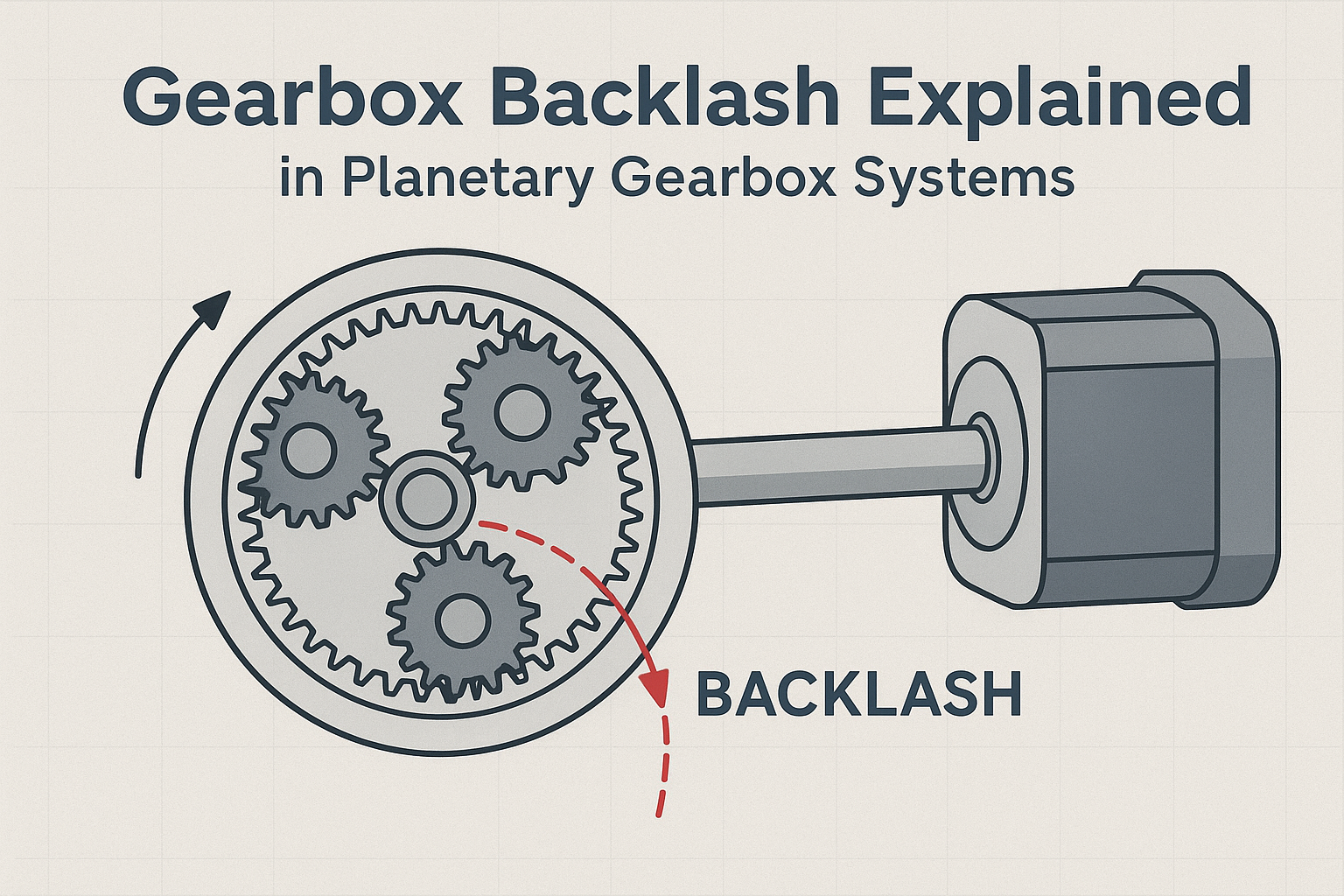
Gearbox backlash is a critical mechanical characteristic in motion control systems. In applications using stepper motors and planetary gearboxes, backlash directly affects positioning accuracy, repeatability, and system stability.
Gearbox backlash is the small amount of free movement between meshing gear teeth when the direction of rotation changes. This lost motion occurs because a clearance must exist between gears to allow lubrication, thermal expansion, and smooth operation.
When a motor reverses direction, the input shaft rotates slightly before the output shaft responds. This delay is defined as backlash.
Backlash becomes especially important in applications that require frequent direction changes, high positioning accuracy, or closed-loop control. Even a small amount of backlash can cause noticeable positioning errors.
| Gearbox Type | Typical Backlash |
|---|---|
| Spur Gearbox | 15–30 arcmin |
| Worm Gearbox | 20–60 arcmin |
| Standard Planetary Gearbox | 10–15 arcmin |
| Precision Planetary Gearbox | ≤ 5 arcmin |
| Low-Backlash Planetary Gearbox | ≤ 3 arcmin |
Planetary gearboxes use multiple planet gears to share the load evenly. This symmetrical load distribution reduces tooth clearance and improves torsional rigidity. As a result, planetary gearboxes offer significantly lower backlash compared to spur or worm designs.
This is why planetary gearboxes are widely used with stepper motors in precision automation systems.
Increasing the planetary gear ratio increases output torque and resolution, but may also increase total system backlash. High-quality planetary gearboxes are designed to control backlash even at higher ratios.
Stepper motors themselves have no mechanical backlash. However, backlash is introduced when combined with gearboxes, lead screws, or belt drives. This makes gearbox selection critical in precision motion systems.
Gearbox backlash is not a defect, but a mechanical design parameter. Understanding backlash helps engineers select the right planetary gearbox to achieve high accuracy, smooth motion, and long service life.
Backlash is often specified in arcminutes. To understand its effect on linear or angular positioning, engineers convert backlash into angular or linear displacement.
Angular Error (degrees) = Backlash (arcmin) ÷ 60
Linear Error (mm) = (Angular Error × π × Output Diameter) ÷ 360
| Parameter | Value |
|---|---|
| Gearbox Backlash | 10 arcmin |
| Angular Error | 0.167° |
| Output Diameter | 20 mm |
| Linear Position Error | ≈ 0.058 mm |
This calculation shows how even small backlash values can significantly affect precision positioning applications.
Backlash performance should always be evaluated at the system level. While gearbox backlash cannot be eliminated entirely, it can be effectively controlled through proper gearbox selection, ratio matching, and mechanical design.
For stepper motor applications requiring higher torque and improved positioning resolution, a planetary gearbox with controlled backlash offers a reliable solution. Lower backlash values help reduce reversal error, improve repeatability, and enhance overall motion stability.
To compare typical backlash values, gear ratios, and torque capabilities, you may refer to our NEMA 17 planetary gearbox configurations below:
If backlash performance is critical for your application, consider selecting a lower ratio or a precision planetary gearbox option, and evaluate the complete drive train including motor, coupling, and load.