Our Location
1103A Tianhui Building, Yeqin 1st Road, Longcheng Street, Shenzhen, Guangdong, China
1103A Tianhui Building, Yeqin 1st Road, Longcheng Street, Shenzhen, Guangdong, China
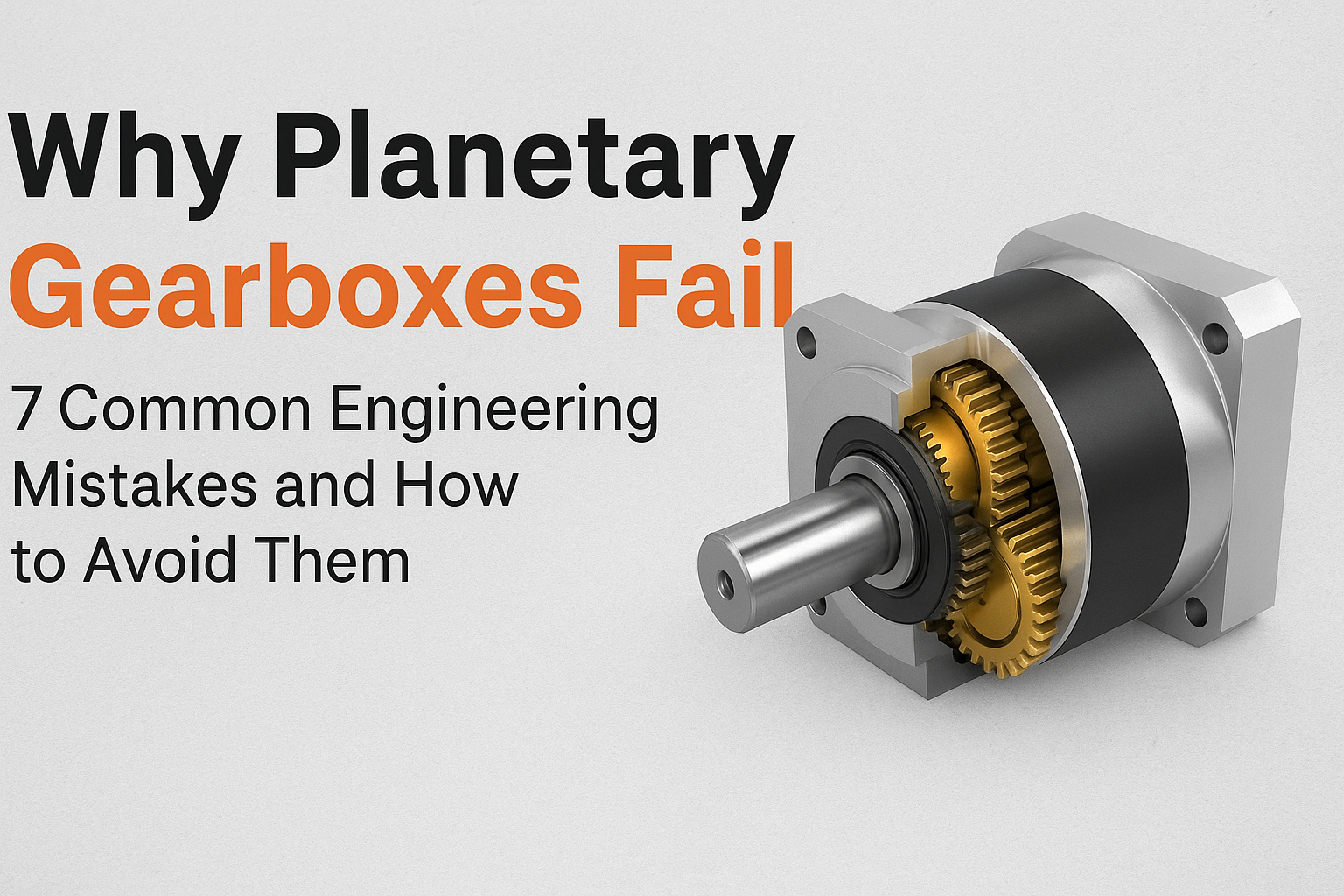
Planetary gearboxes are widely used in automation, robotics, and precision motion systems due to their compact size and high torque density. However, gearbox failure is still one of the most common complaints in industrial applications.
In reality, most planetary gearbox failures are not caused by manufacturing defects. They are the result of incorrect selection, improper integration, or misunderstanding of operating conditions.
This article explains the most common engineering mistakes that lead to planetary gearbox failure and how to avoid them in real-world applications.
Choosing the wrong planetary gear ratio is the most frequent cause of gearbox failure. Many users assume that a higher gear ratio automatically means better performance. In practice, excessive reduction ratios significantly increase internal stress and system inertia.
For example, using a 50:1 planetary gearbox where a 10:1 solution is sufficient may lead to:
Instead of selecting the highest possible ratio, gear ratio should be chosen based on real load torque, required speed, and duty cycle.
If you are comparing different ratios for NEMA 17 applications, see our planetary gear motor solutions with optimized ratios: NEMA 17 Planetary Gear Motor Series
Planetary gearboxes do not transmit torque at 100% efficiency. Each reduction stage introduces efficiency losses, typically 90–95% per stage.
When users calculate output torque using only motor torque × gear ratio, the gearbox may be unintentionally overloaded. This often results in gear tooth wear or premature bearing failure.
Proper torque calculation must include gearbox efficiency and a safety factor of at least 1.5×.
Backlash is often misunderstood or completely ignored during gearbox selection. In precision positioning systems, excessive backlash can cause:
For applications requiring accurate positioning or smooth motion reversal, low-backlash planetary gearboxes are essential. This is especially important in robotic joints and linear actuators.
Vertical axis applications are one of the most common causes of planetary gearbox failure. Gravity introduces continuous load and shock forces during acceleration and deceleration.
If the gearbox is selected based only on horizontal load calculations, it will fail prematurely in vertical use.
For vertical systems, always:
Higher ratios such as 20:1 or 50:1 are commonly used for vertical loads, but only when properly calculated.
Improper alignment between the stepper motor shaft and planetary gearbox input shaft creates uneven load distribution. This leads to bearing stress, gear wear, and noise.
Integrated planetary gear motors reduce alignment risk by combining the motor and gearbox into a single assembly.
If alignment accuracy is critical, consider integrated planetary gear motor designs instead of separate motor and gearbox assemblies.
Planetary gearboxes are rated not only by torque but also by duty cycle. Continuous high-load operation without sufficient cooling accelerates lubricant breakdown and gear wear.
Common mistakes include:
Correct selection balances torque, speed, and thermal performance over the entire operating cycle.
Planetary gearboxes are not one-size-fits-all components. The same gearbox may perform perfectly in one application and fail quickly in another.
Key parameters such as load inertia, acceleration profile, mounting orientation, and service life expectations must all be considered.
This is why gearbox selection should be treated as an engineering decision, not just a catalog choice.
To avoid common gearbox failures:
If you are selecting a planetary gear motor for a NEMA 17 system and are unsure about the correct ratio, our engineering team can help verify torque, speed, and long-term reliability.
Contact our engineers for technical support and gearbox selection guidance.
Stepper motors are widely used in automation and motion control systems.
To explore different specifications and configurations, please visit our
Stepper Motor solutions