Our Location
1103A Tianhui Building, Yeqin 1st Road, Longcheng Street, Shenzhen, Guangdong, China
1103A Tianhui Building, Yeqin 1st Road, Longcheng Street, Shenzhen, Guangdong, China
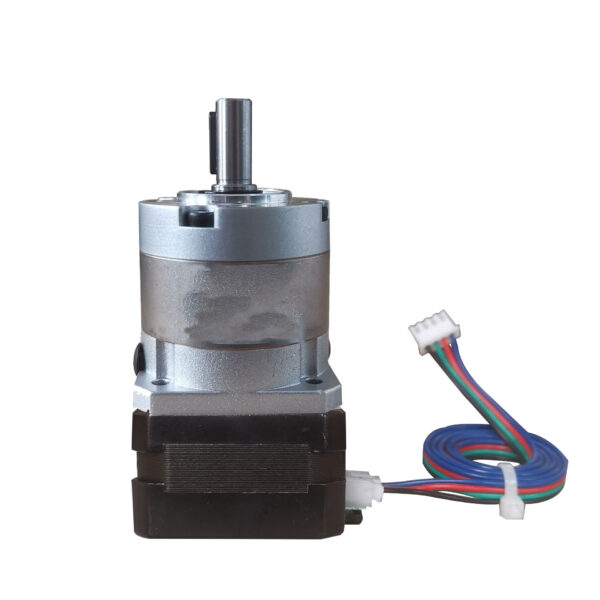
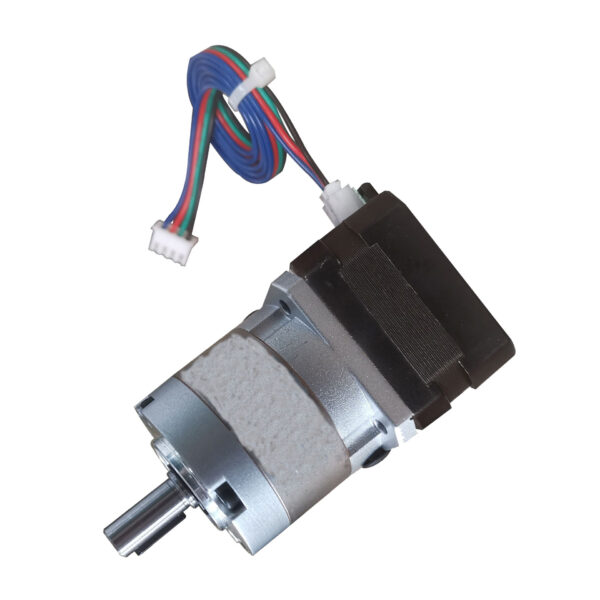
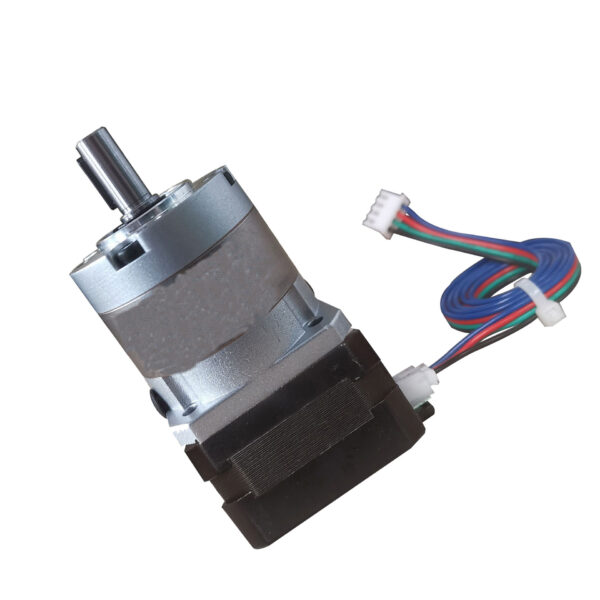
Compact NEMA 17 0.9-degree stepper motor combined with a high-precision planetary gearbox, featuring a short output shaft and terminal wire connection. Designed for applications requiring high torque density, stable speed reduction, and accurate positioning in limited installation space.
This product integrates a NEMA 17 0.9-degree stepper motor with a compact and efficient
planetary gearbox, offering higher torque output, precise speed control, and excellent durability.
The short shaft design and terminal wire connection make it ideal for space-constrained automation systems.
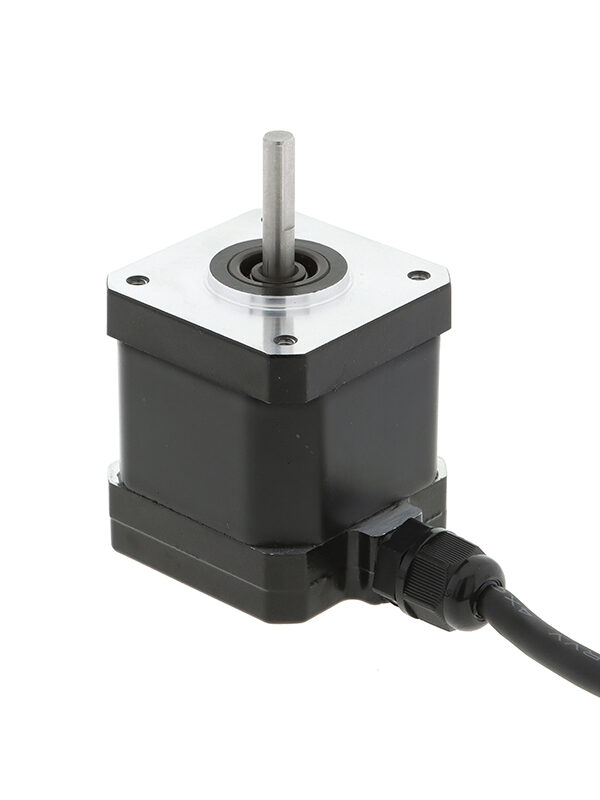
The stepper motor section is based on a reliable 0.9° short shaft design.
If you need the motor alone, you can refer to this model:
NEMA 17 Ultra Thin Pancake Stepper Motor
| Item | Specification |
|---|---|
| Frame Size | NEMA 17 (42 × 42 mm) |
| Step Angle | 0.9° ±5% |
| Number of Phases | 2 |
| Phase Voltage | 3.36 VDC |
| Phase Current | 1.4 A |
| Phase Resistance | 2.4 Ω ±10% (20°C) |
| Phase Inductance | 5.5 mH ±20% |
| Holding Torque (Motor Only) | 0.18 N·m |
| Insulation Class | Class B |
| Insulation Resistance | 100 MΩ min. (500V DC) |
| Ambient Temperature | -20°C to +50°C |
| Motor Weight | Approx. 0.24 kg |
| Item | Specification |
|---|---|
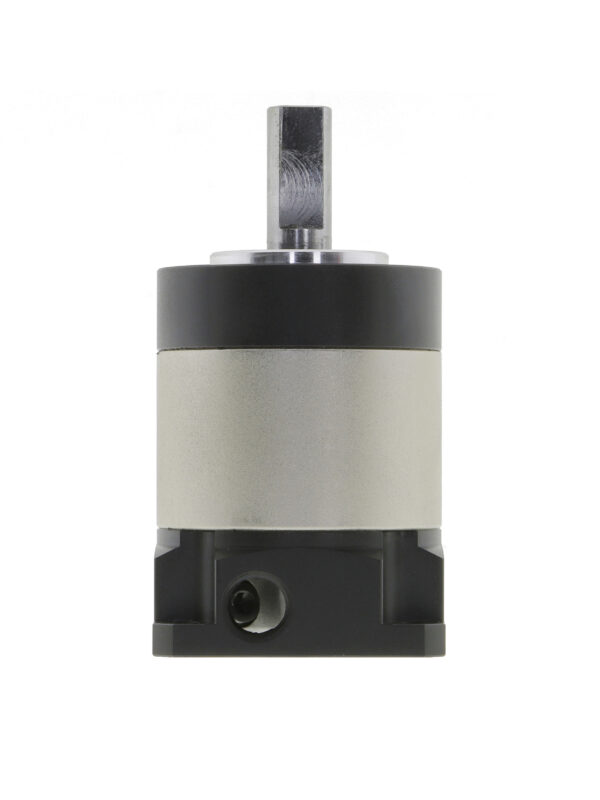
| Gearbox Type | Planetary Gearbox |
| Gear Stages | Level 1 / Level 2 |
| Efficiency | 96% (Level 1), 94% (Level 2) |
| Backlash | < 15 arcmin (Level 1), < 20 arcmin (Level 2) |
| Noise | < 55 dB |
| Output Shaft | Short Shaft (Customizable) |
| Reduction Ratio | Rated Load (N·m) | Gearbox Length (mm) |
|---|---|---|
| 3 : 1 | 8 | 40 |
| 4 : 1 | 9 | 40 |
| 5 : 1 | 9 | 40 |
| 10 : 1 | 10 | 40 |
| 16 : 1 | 10 | 51 |
| 20 : 1 | 10 | 51 |
| 25 : 1 | 10 | 51 |
| 35 : 1 | 10 | 51 |
| 40 : 1 | 10 | 51 |
| 50 : 1 | 10 | 51 |
| 70 : 1 | 10 | 51 |
| Gear Ratio | Application Focus | Product Page |
|---|---|---|
| 3 : 1 | High speed, low torque increase | View 3:1 planetary gearbox |
| 10 : 1 | Balanced speed and torque | View 10:1 planetary gearbox |
| 5 : 1 | Balanced speed and torque | View 5:1 planetary gearbox |
| 20 : 1 | Balanced speed and torque | View 20:1 planetary gearbox |
| 50 : 1 | Maximum torque output | View 50:1 planetary gearbox |
Selecting the correct planetary gear motor requires understanding how motor torque is amplified through the gearbox.
The output torque depends on three key factors: motor torque, gear ratio, and gearbox efficiency.
Output Torque (Nm) =
Motor Torque (Nm) × Gear Ratio × Gearbox Efficiency
Planetary gearboxes typically have an efficiency of 90%–95% per stage.
Assume a NEMA 17 stepper motor with a holding torque of 0.45 Nm is paired with a 20:1 planetary gearbox.
Output Torque ≈ 0.45 × 20 × 0.95 = 8.55 Nm
This significant torque increase makes planetary gear motors ideal for applications such as
vertical axes, linear actuators, and precision positioning systems.
| Gear Ratio | Torque Increase | Typical Applications |
|---|---|---|
| 5:1 | ~4.3× motor torque | Light automation, fast positioning, compact mechanisms |
| 10:1 | ~8.5× motor torque | Indexing tables, conveyors, small robotic joints |
| 20:1 | ~17× motor torque | Linear actuators, vertical loads, precision automation |
| 50:1 | ~42× motor torque | Lifting systems, heavy-duty positioning, low-speed high-load axes |
If you are unsure which planetary gear ratio or motor combination fits your load and speed requirements,
our engineers can help you verify torque, speed, and service life before ordering.
✔ Load & torque calculation support
✔ Custom gear ratios and motor configurations
✔ OEM and bulk order solutions
| Wire Color | Function |
|---|---|
| Black (BLK) | Phase A+ |
| Green (GRN) | Phase A− |
| Red (RED) | Phase B+ |
| Blue (BLU) | Phase B− |
This planetary gearbox stepper motor solution is widely used in automation equipment,robot joints, packaging machines, laboratory instruments, and positioning systems where high torque and accurate motion control are required.
Selecting the correct planetary gear ratio depends on load torque, speed requirements, and positioning accuracy.
FAQ 1: Which applications are best for a planetary gearbox stepper motor?
Planetary gear motor systems are widely used in applications that require compact size, high torque density, and precise motion control.
Typical applications include industrial automation equipment, robotic joints, linear actuators, precision conveyors, and positioning tables.
Lower ratios such as 5:1 or 10:1 are often used for speed-sensitive motion, while higher ratios like 20:1 or 50:1 are preferred for high-load or vertical axis applications.
FAQ 2: How do I choose the right planetary gear ratio for my application?
Choosing the correct planetary gear ratio depends on three key factors:
required torque, output speed, and load inertia.
5:1 – 10:1: light to medium loads, higher speed, smooth motion
20:1: balance between torque and precision positioning
50:1: heavy loads, low speed, maximum holding torque
If you are unsure, our engineers can help calculate the optimal ratio based on your motor and load parameters.
FAQ 3: Are planetary gearboxes suitable for continuous operation?
Yes. High-quality planetary gearboxes are designed for continuous industrial operation.
Thanks to multiple planet gears sharing the load, they provide excellent durability, low backlash, and stable torque transmission over long service life.
FAQ 4: Can a planetary gearbox be used with linear actuators or lead screw systems?
Absolutely. Planetary gear motors are commonly combined with lead screw actuators or linear motion systems to increase thrust force and positioning accuracy.
This configuration is widely used in automation modules, packaging machinery, and precision adjustment mechanisms.
Not sure which planetary gear ratio fits your application?
Our engineering team can help you select the right gearbox, motor, and configuration based on your load, speed, and precision requirements.
✔ Custom gear ratios available
✔ OEM & bulk orders supported
✔ Fast technical response for engineers
Download the full specification sheet for detailed parameters, wiring guide, and performance curves.

Reviews
There are no reviews yet.