Our Location
1103A Tianhui Building, Yeqin 1st Road, Longcheng Street, Shenzhen, Guangdong, China
1103A Tianhui Building, Yeqin 1st Road, Longcheng Street, Shenzhen, Guangdong, China
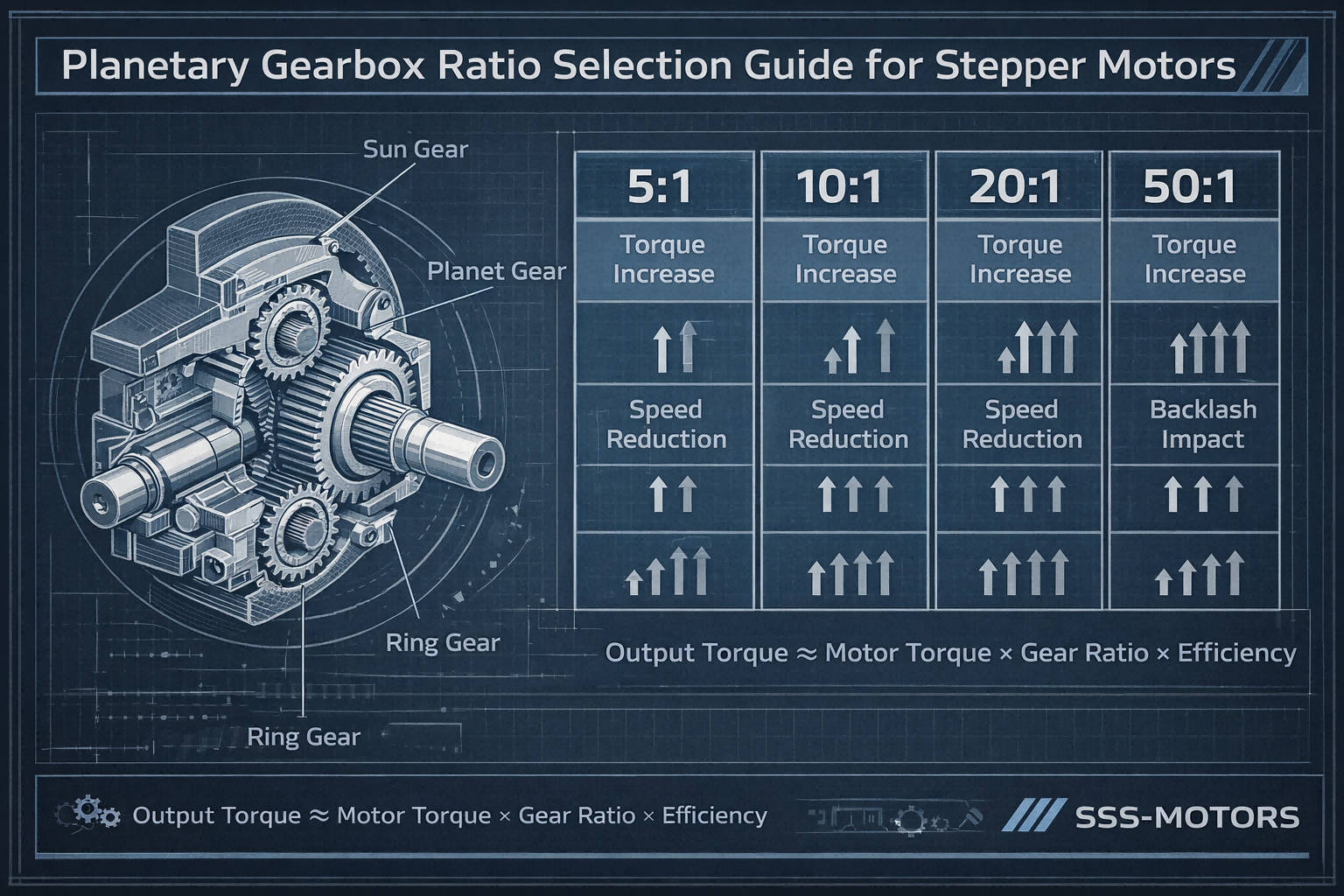
Planetary gearboxes are widely used in stepper motor systems where compact size, high torque density, and precise motion control are required. This engineering guide explains how planetary gearboxes work, how gear ratios affect performance, and how to select the right planetary gearbox for stepper motor applications.
A planetary gearbox consists of a central sun gear, multiple planet gears, and an outer ring gear. This configuration allows torque to be distributed across multiple contact points, resulting in high torque output within a compact, coaxial structure.
In stepper motor applications, planetary gearboxes are commonly used to increase output torque, improve positioning resolution, and maintain high transmission efficiency compared to worm or spur gear systems.
→ Related product: NEMA 17 Stepper Motor Gearbox (Planetary Gear Motor)
Compared to spur gearboxes, planetary gearboxes offer higher torque density, better load distribution, and a more compact footprint. Spur gear systems typically require larger gear diameters to achieve the same torque output.
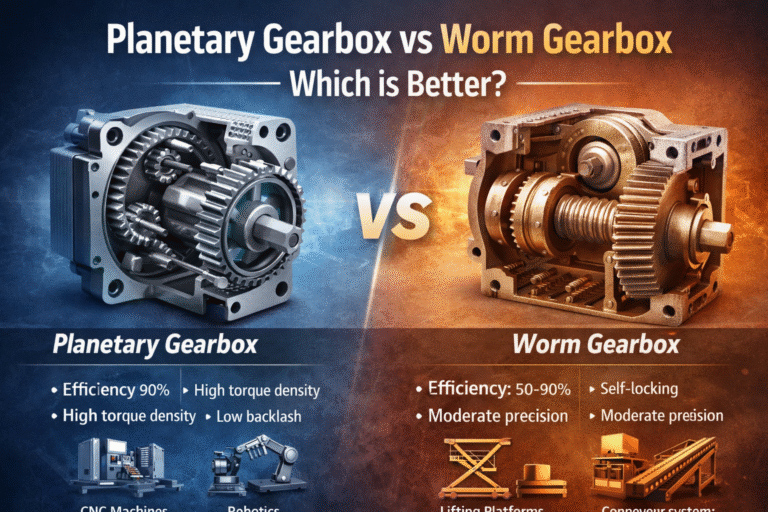
Worm gearboxes provide self-locking characteristics but suffer from low efficiency and heat generation. Planetary gearboxes maintain efficiency levels above 90% while offering lower backlash and longer service life.
→ Engineering comparison: Why Integrated Planetary Gear Motors Outperform Separate Assemblies
Gear ratio directly determines the relationship between motor speed and output torque. Higher planetary gear ratios increase torque output while proportionally reducing rotational speed.
For example, a 10:1 planetary gearbox multiplies motor torque by approximately ten times (minus mechanical losses), while reducing output speed to one-tenth of the motor speed.
→ Detailed selection guide: Planetary Gearbox Ratio Selection Guide
Backlash is the angular clearance between mating gear teeth. In precision motion systems, excessive backlash can lead to positioning errors, inconsistent repeatability, and vibration during direction changes.
Planetary gearboxes designed for stepper motors typically achieve backlash values below 15 arcminutes, making them suitable for positioning and indexing applications.
Zero backlash gearboxes are often misunderstood. In practice, mechanical systems require a small amount of backlash to allow lubrication, thermal expansion, and long-term reliability. Low backlash planetary gearboxes offer the optimal balance between precision and durability.
→ Technical deep dive: Low Backlash vs Zero Backlash: Engineering Misconceptions
→ Related article: Gearbox Backlash Explained for Motion Engineers
An integrated planetary gear motor combines the stepper motor and planetary gearbox into a single aligned assembly. This reduces concentricity errors, improves torque transmission, and simplifies installation.
Compared to separate motor and gearbox assemblies, integrated solutions offer:
→ Engineering analysis: Why Integrated Planetary Gear Motors Are Better
Encoders are used when closed-loop feedback, position verification, or fault detection is required. In planetary gear motor systems, encoders are commonly installed on the motor shaft to monitor rotation before gear reduction.
Applications that benefit from encoders include CNC indexing, robotics joints, and automated positioning systems requiring high repeatability.
→ Learn more: Stepper Motor with Encoder: Engineering Guide
Each application may require different planetary gear ratios, torque ratings, and backlash specifications depending on load and precision requirements.
When selecting a planetary gearbox for a stepper motor system, engineers should evaluate:
→ Final selection reference: Planetary Gearbox Ratio Selection Guide
→ View integrated solutions: NEMA 17 Integrated Planetary Gear Motor Series
Selecting a planetary gearbox for a stepper motor system requires balancing torque, speed, backlash, and mechanical efficiency. Integrated planetary gear motors simplify this process by ensuring optimal alignment between the motor and gearbox.
For engineers working with compact automation systems, NEMA 17 planetary gear motors are widely used due to their standardized mounting, flexible gear ratios, and compatibility with stepper motor drivers.
→ Engineering reference: NEMA 17 Integrated Planetary Gear Motor Series
→ Gear ratio selection: Planetary Gearbox Ratio Selection Guide