Our Location
1103A Tianhui Building, Yeqin 1st Road, Longcheng Street, Shenzhen, Guangdong, China
1103A Tianhui Building, Yeqin 1st Road, Longcheng Street, Shenzhen, Guangdong, China
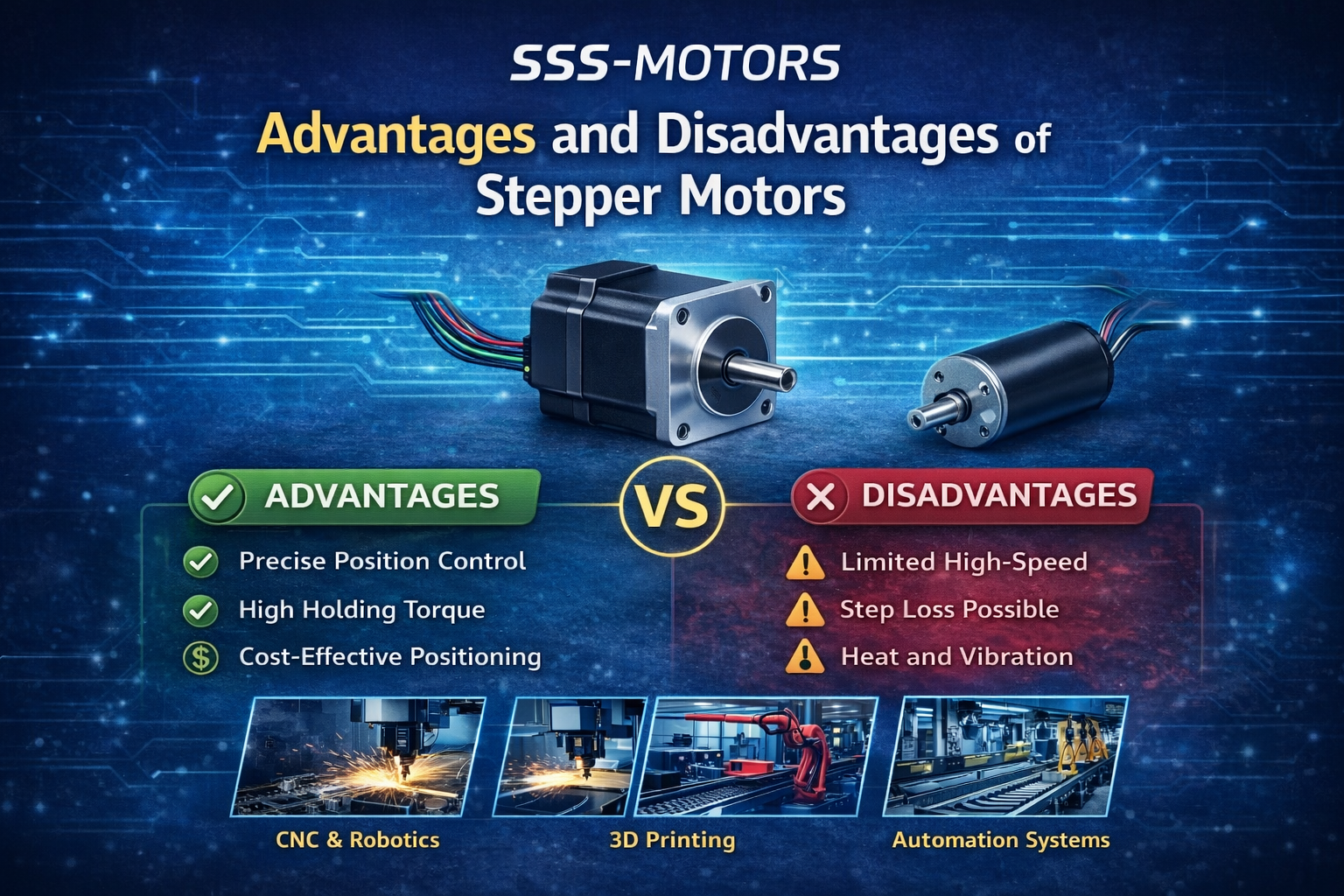
Stepper motors are widely used in motion control and automation systems
because of their precise positioning and simple control.
However, like any motor technology, stepper motors have both advantages
and disadvantages that should be carefully considered during system design.
If you are new to stepper motors, you may first read
What Is a Stepper Motor
and
How Does a Stepper Motor Work
for a basic understanding.
For industrial automation solutions, you can explore our
Stepper Motor solutions
used in CNC, robotics, and positioning applications.
One of the main advantages of stepper motors is their ability to provide
accurate and repeatable positioning.
Each input pulse moves the motor shaft by a fixed step angle,
allowing precise control without feedback in many applications.
Stepper motors generate high holding torque when stationary.
This makes them ideal for applications that require the motor
to hold a load in position without additional braking mechanisms.
Stepper motors are easy to control using digital pulse signals.
They integrate well with PLCs, microcontrollers, and CNC controllers,
making system design relatively simple and cost-effective.
Because stepper motors move in discrete steps,
they provide consistent and repeatable motion,
which is essential in automation and positioning systems.
Compared to servo systems, stepper motors typically require
less complex control electronics and tuning,
resulting in lower overall system cost for many applications.
Stepper motor torque decreases rapidly as speed increases.
At high speeds, stepper motors may lose torque and
become less suitable for dynamic applications.
In open-loop control, the controller assumes the motor
follows the commanded pulses.
Under excessive load or acceleration,
the motor may lose steps without detection.
Stepper motors often draw current even when holding position,
which can lead to lower efficiency and increased heat generation
compared to other motor types.
Due to step-by-step motion, stepper motors can produce
vibration and audible noise, especially at low speeds.
Microstepping can help reduce these effects but may not eliminate them entirely.
For applications requiring very high torque or power density,
stepper motors may be larger and heavier than servo motors
designed for similar performance.
Many of the disadvantages of stepper motors can be mitigated
through proper system design.
Stepper motors are an excellent choice for applications
that require precise positioning, repeatability,
and cost-effective motion control.
For high-speed, high-dynamic, or high-efficiency applications,
servo motors or closed loop stepper motors may be more suitable.
You can find different configurations, including closed loop options,
in our
Stepper Motor product category
to match your application requirements.
If you are planning to select a stepper motor for your application,
this step-by-step guide explains the key factors you should consider:
How to Choose a Stepper Motor