Our Location
1103A Tianhui Building, Yeqin 1st Road, Longcheng Street, Shenzhen, Guangdong, China
1103A Tianhui Building, Yeqin 1st Road, Longcheng Street, Shenzhen, Guangdong, China
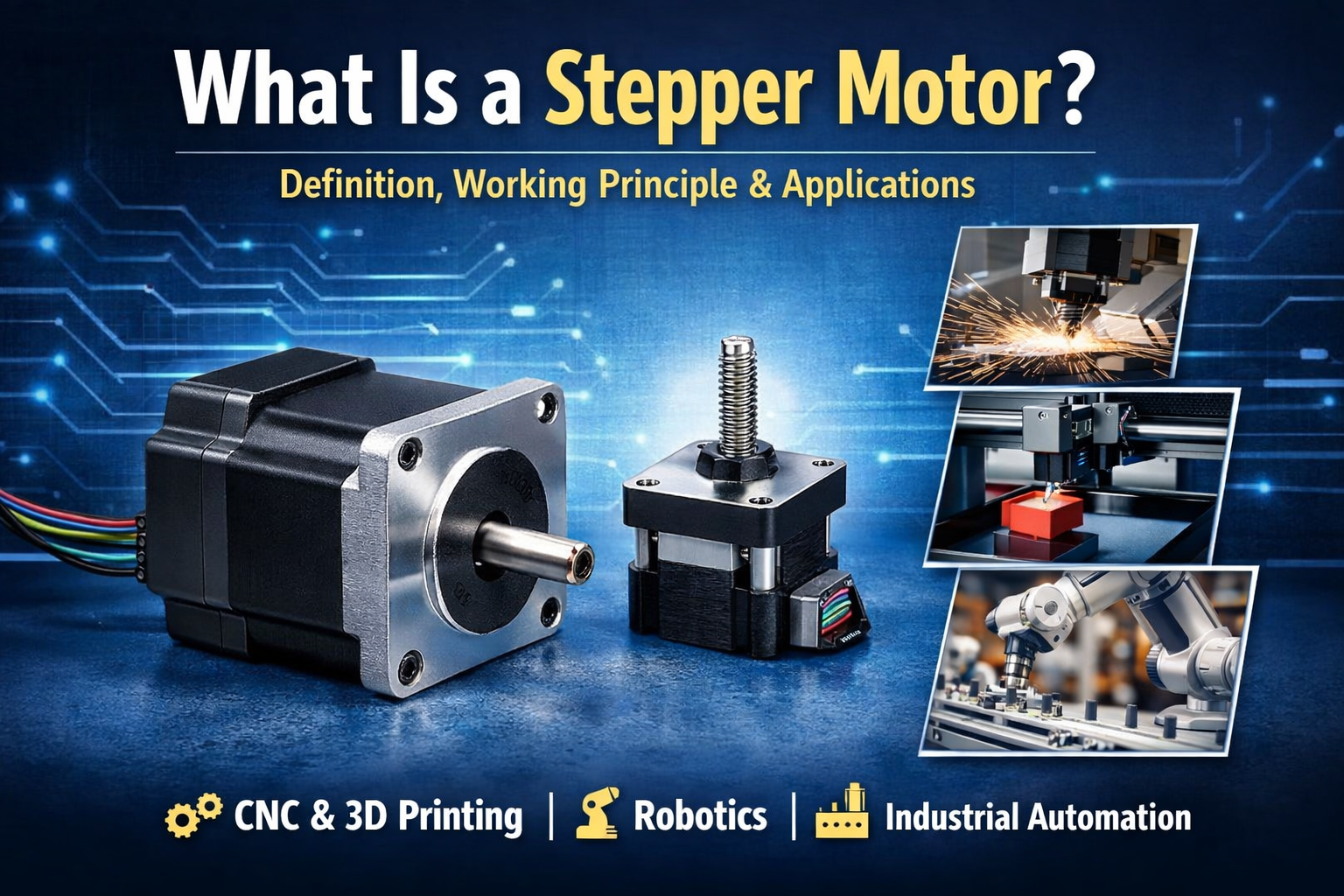
A stepper motor is a type of electric motor that moves in discrete steps,
allowing precise control of position, speed, and rotation angle.
Unlike conventional DC or AC motors, a stepper motor rotates in fixed
increments when electrical pulses are applied.
Because of this step-by-step movement, stepper motors are widely used in
applications requiring accurate positioning, such as CNC machines,
3D printers, robotics, and industrial automation systems.
If you are looking for industrial-grade solutions, you can explore our
Stepper Motor solutions
designed for automation and OEM applications.
A stepper motor works by energizing its internal coils in a specific sequence.
Each electrical pulse causes the motor shaft to rotate by a fixed angle,
known as the step angle.
For example, a common stepper motor with a 1.8° step angle requires
200 pulses to complete one full revolution (360° ÷ 1.8° = 200 steps).
By controlling the number and frequency of pulses, the motor controller
can accurately manage the motor’s position and speed.
Permanent magnet stepper motors use a magnetized rotor and provide
good torque at low speeds. They are typically used in low-power
and cost-sensitive applications.
Variable reluctance stepper motors have a soft iron rotor and rely on
magnetic reluctance to generate motion. These motors offer fast response
but relatively lower torque.
Hybrid stepper motors combine the features of permanent magnet and
variable reluctance designs. They offer high torque, better accuracy,
and finer step resolution. Most NEMA stepper motors used in industrial
applications are hybrid stepper motors.
Stepper motors are commonly used in applications where accurate positioning
and repeatability are required.
Compared with DC motors and AC servo motors, stepper motors offer a simpler
and more cost-effective solution for precise positioning, especially in
low to medium speed applications.
However, for high-speed or high-dynamic applications, closed loop stepper
motors or servo motors may be more suitable. Choosing the right motor
depends on torque requirements, speed, accuracy, and system complexity.
When selecting a stepper motor, key factors to consider include required torque,
operating speed, voltage, step angle, and control method.
Understanding your application requirements will help you choose the most
suitable motor configuration.
To explore different types and specifications, visit our
Stepper Motor product category
for detailed technical options and customization support.
If you are planning to select a stepper motor for your application,
this step-by-step guide explains the key factors you should consider:
How to Choose a Stepper Motor
.
The main advantage of a stepper motor is precise position control without requiring a feedback system. Stepper motors move in fixed increments, making them ideal for CNC machines, 3D printers, and positioning systems.
Yes, stepper motors can run continuously when properly driven. However, they are typically used for positioning applications rather than continuous high-speed rotation.
Stepper motors are driven by DC power through a stepper motor driver, which converts DC voltage into controlled pulses that move the motor step by step.
Most stepper motors do not require encoders because they operate in open-loop control systems. Closed-loop stepper motors include encoders for improved positioning reliability.
The most common types include permanent magnet stepper motors, variable reluctance stepper motors, and hybrid stepper motors. Hybrid stepper motors are widely used in industrial automation.
Stepper motors are widely used in CNC machines, 3D printers, robotics systems, medical equipment, and automated inspection platforms.