Our Location
1103A Tianhui Building, Yeqin 1st Road, Longcheng Street, Shenzhen, Guangdong, China
1103A Tianhui Building, Yeqin 1st Road, Longcheng Street, Shenzhen, Guangdong, China
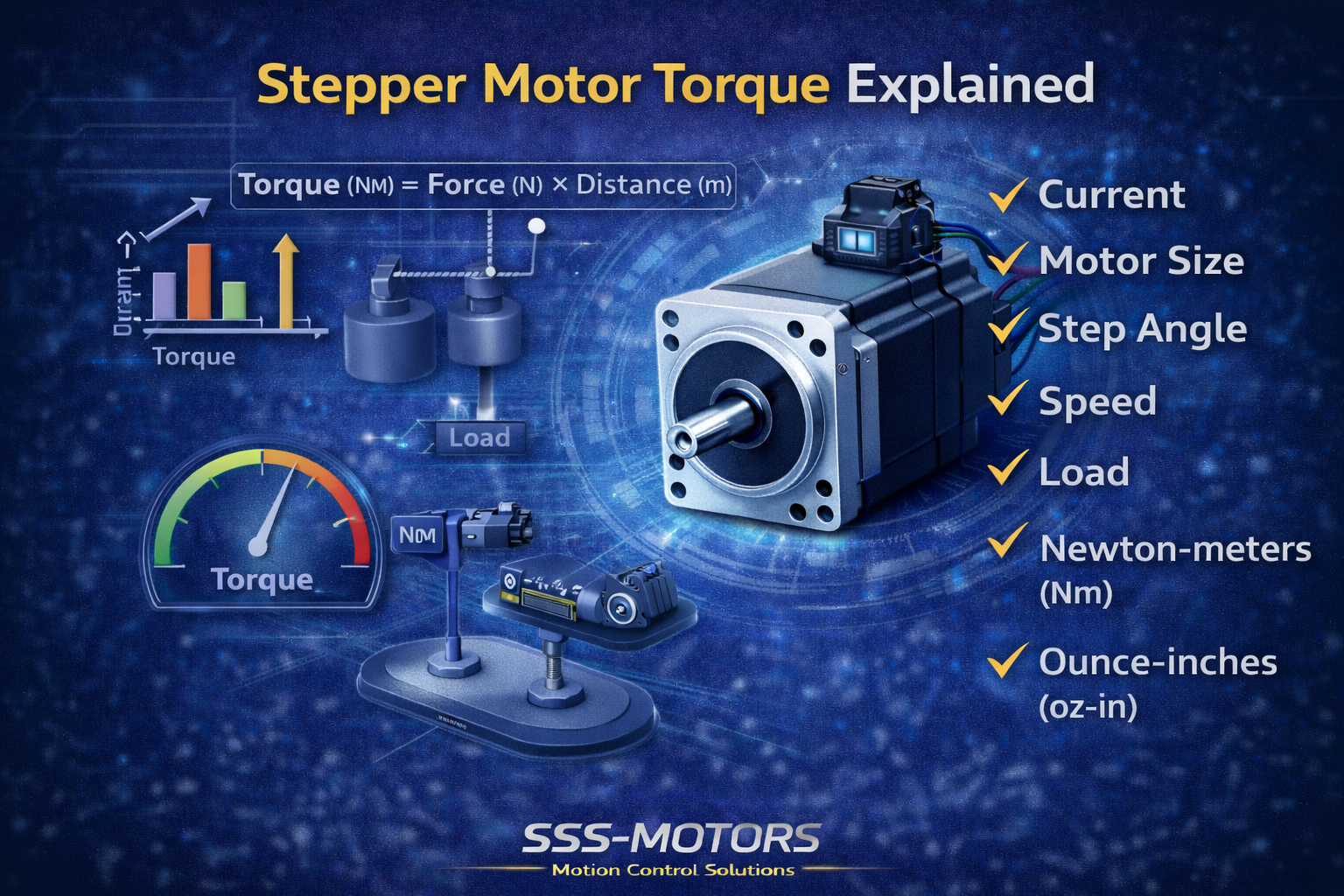
Stepper motor torque is a crucial factor in determining how well a stepper motor will perform in a given application.
It refers to the rotational force that the motor produces to move or hold a load.
In this article, we will explain what stepper motor torque is, how it is calculated, and how to select the appropriate torque for your system.
Torque is the rotational force that a stepper motor generates to perform mechanical work.
It is typically measured in **Newton-meters (Nm)** or **ounce-inches (oz-in)**.
The torque produced by a stepper motor determines its ability to move a load or keep a position under load.
For example, if a motor has a high torque, it can handle heavier loads or perform tasks requiring more force, such as turning larger wheels or actuating linear motion.
Torque in a stepper motor is a function of several factors, including motor size, step angle, current, and voltage.
In general, torque is proportional to the current supplied to the motor. The more current the motor receives, the more torque it will produce.
However, it is also affected by other parameters such as the motor’s frame size, step angle, and speed.
One of the primary ways to control the torque in a stepper motor is by adjusting the current.
As the current increases, the motor’s torque capacity also increases, allowing it to handle more substantial loads.
However, this also generates more heat, which may require cooling mechanisms to maintain efficiency.
Several factors influence the torque a stepper motor can produce:
To calculate the required torque for your stepper motor, you need to know the following parameters:
A common approach is to use the formula:
Torque (Nm) = Force (N) × Distance (m)
Where Force is the load applied to the motor (calculated from the weight of the object), and Distance is the radius of the motor shaft or the point of application.
| Motor Model | Holding Torque (Nm) | Peak Torque (Nm) | Recommended Speed (RPM) | Frame Size |
|---|---|---|---|---|
| NEMA 17 – 2A | 0.45 Nm | 0.6 Nm | 1000 RPM | NEMA 17 |
| NEMA 23 – 4A | 1.2 Nm | 1.5 Nm | 1500 RPM | NEMA 23 |
| NEMA 34 – 6A | 2.5 Nm | 3.2 Nm | 1800 RPM | NEMA 34 |
Compare different motor models based on holding torque, peak torque, speed, and frame size to choose the right motor for your application.
The torque generated by a stepper motor can be influenced by several factors. Understanding these factors is essential for selecting the right motor for your application. Below are the key factors that impact stepper motor torque:
Understanding how each of these factors influences your motor’s performance will help you select the right motor for your specific needs.
Use the tool below to calculate the required torque for your application.
Tip: For stepper motors, effective radius is usually 0.01–0.03 m (10–30 mm).
When selecting a stepper motor for your application, it’s essential to choose a motor that provides enough torque to handle the load while avoiding excessive torque, which can lead to overheating and inefficiency. Below are some guidelines for selecting the right torque:
Although torque calculations provide a theoretical reference, actual motor performance depends heavily on wiring configuration. For instance, a 4-wire bipolar stepper motor delivers torque differently compared to a 6-wire motor wired in unipolar mode. Therefore, understanding wiring diagrams is essential before final motor selection.
If you are not familiar with motor wiring types, read our detailed guide: Stepper Motor Wiring Diagram, which explains 4-wire, 6-wire, and 8-wire stepper motor wiring step by step.
Stepper motors are used in a wide variety of applications, where precise movement and torque are required. Some common applications include:
Choosing the right stepper motor torque is essential for ensuring your system runs smoothly and efficiently.
By understanding how torque is calculated and considering the various factors that influence motor performance, you can make an informed decision when selecting a stepper motor for your application.
For more detailed guidance and to explore our stepper motor solutions, you can browse our
Stepper Motor product category
or contact us for technical support.
Need more help selecting the right motor for your application? Our experts are here to assist you.



[…] For detailed technical explanation see: stepper motor torque speed curve […]