Our Location
1103A Tianhui Building, Yeqin 1st Road, Longcheng Street, Shenzhen, Guangdong, China
1103A Tianhui Building, Yeqin 1st Road, Longcheng Street, Shenzhen, Guangdong, China
Closed loop stepper motors and servo motors are both widely used
in industrial motion control applications.
While servo systems are traditionally associated with high performance,
closed loop stepper motors have become a popular alternative
in many automation and CNC systems.
Understanding the differences between these two motor technologies
can help you select the most cost-effective and reliable solution
for your application.
If you are new to closed loop technology, you may also read
Closed Loop vs Open Loop Stepper Motor
and
How to Choose a Stepper Motor
for selection guidance.
A closed loop stepper motor combines a stepper motor
with an encoder feedback system.
The controller monitors the motor position in real time
and corrects position errors automatically.
This design maintains the simplicity of stepper motors
while significantly improving reliability and efficiency.
A servo motor is a closed loop system that continuously adjusts
motor position, speed, and torque based on feedback.
Servo motors typically offer higher speed capability
and smoother motion than stepper motors.
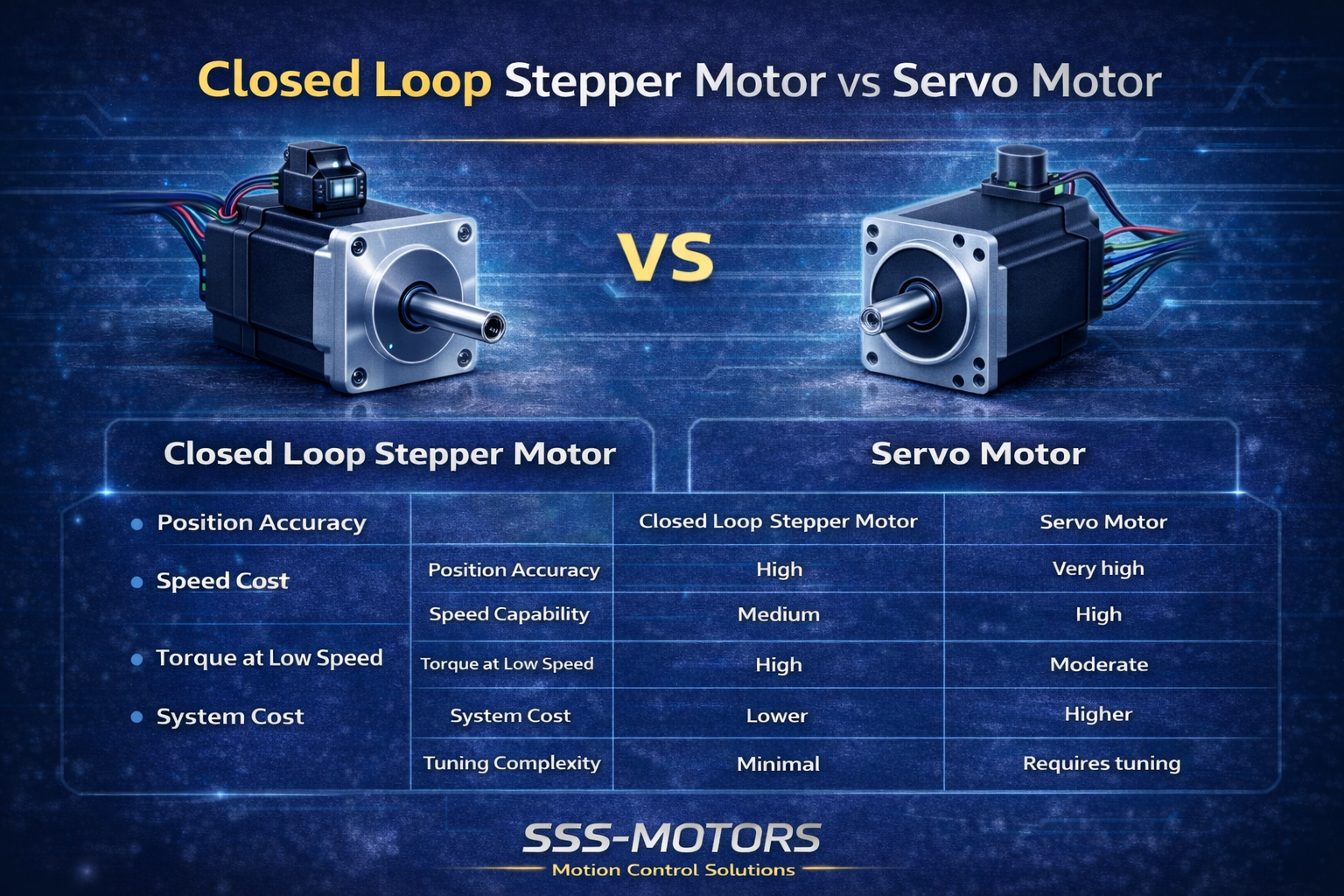
| Feature | Closed Loop Stepper Motor | Servo Motor |
|---|---|---|
| Control Method | Step-based with encoder feedback | Continuous feedback control |
| Position Accuracy | High, with step correction | Very high |
| Speed Capability | Medium | High |
| Torque at Low Speed | High | Moderate |
| System Cost | Lower | Higher |
| Tuning Complexity | Minimal | Requires tuning |
Servo motors excel in high-speed and dynamic applications
that require smooth continuous motion.
Closed loop stepper motors perform exceptionally well
in applications requiring high torque at low speed,
precise positioning, and stable operation.
Closed loop stepper motor systems are generally more affordable
than servo systems.
They also require less tuning and simpler integration,
reducing setup time and engineering cost.
Servo systems offer superior performance
but at a higher initial cost and increased system complexity.
In many medium-duty industrial applications,
a closed loop stepper motor can replace a servo motor
while offering significant cost savings.
If the application does not require extremely high speed
or dynamic response,
closed loop stepper motors provide an excellent balance
between performance, reliability, and cost.
Choose a closed loop stepper motor
if you need reliable positioning, high torque at low speed,
and a cost-effective motion control solution.
Choose a servo motor
if your application demands high-speed motion,
smooth continuous control,
and maximum dynamic performance.
For system selection and available solutions,
you can browse our
Stepper Motor products
or contact us for technical support.
After comparing closed loop stepper motors and servo motors,
this step-by-step guide helps you determine
which motor technology best fits your application requirements:
How to Choose a Stepper Motor
.