Our Location
1103A Tianhui Building, Yeqin 1st Road, Longcheng Street, Shenzhen, Guangdong, China
1103A Tianhui Building, Yeqin 1st Road, Longcheng Street, Shenzhen, Guangdong, China
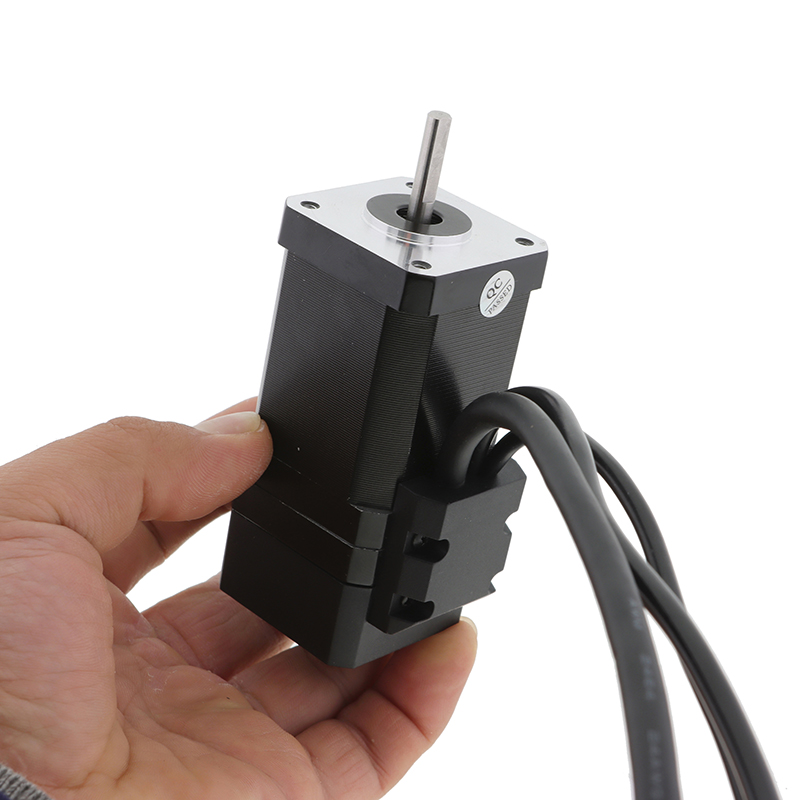
As automation continues to evolve, robotics and intelligent machinery require motors that deliver precise motion control, high torque density, and long-term reliability. The NEMA 17 brushless DC servo motor with encoder has become a preferred choice for engineers and integrators due to its compact size and exceptional performance.
The NEMA 17 standard defines a 42 mm motor frame size, widely used in robotics, 3D printers, CNC platforms, medical devices, and compact automation systems. A brushless electric motor eliminates carbon brushes, reducing wear and improving efficiency. When equipped with an encoder, the motor becomes a closed-loop BLDC servo with position and speed feedback.
An optical encoder provides accurate real-time feedback for the controller to adjust the motor output instantly. This improves:
This makes the Encoder-Equipped Brushless DC Servo Motor ideal for tasks requiring consistent performance and precise repeatability.
| Feature | BLDC Servo Motor | Stepper Motor |
|---|---|---|
| Control System | Closed-loop with feedback | Mostly open-loop |
| Speed Range | High speed, high efficiency | Limited speed |
| Torque at High RPM | Stable | Rapid drop-off |
| Noise Level | Low | Higher noise and vibration |
| Energy Consumption | Lower | Higher |
For robots and automated platforms operating continuously, a BLDC servo motor with encoder offers clear advantages.
These motors are widely applied in:
The common 24V brushless motor supply ensures compatibility with industrial power systems.
Consider these engineering factors:
If you are looking for a compact high-performance solution, explore our:
NEMA 17 Brushless DC Servo Motor with Encoder 24V
This model combines high torque output, 1000-line optical encoder feedback and durable 24V operation, engineered for industrial-grade automation.
Need a custom shaft or cable?
Contact our engineering team for tailored motion solutions.
Email: betty@sss-motors.com
WhatsApp: +86-13528429540
A NEMA 17 brushless DC servo motor with encoder offers unmatched advantages in robotics and automation. If you demand accuracy, efficiency and reliable servo performance, this motor type is a smart investment for your next automation upgrade.
Stepper motors are widely used in automation and motion control systems. To explore different specifications and configurations, please visit our Stepper Motor solutions .