Our Location
1103A Tianhui Building, Yeqin 1st Road, Longcheng Street, Shenzhen, Guangdong, China
1103A Tianhui Building, Yeqin 1st Road, Longcheng Street, Shenzhen, Guangdong, China
If you’ve ever worked with stepper motors, you already know the feeling — the buzz, the vibration, the slight chatter that shows up just when your motion system is almost perfect. It’s the moment every engineer asks: Can this motion be smoother? Can I get more precision without adding a servo system?
That’s where the three-phase stepper motor quietly steps in.
In this article, I’ll walk you through what makes it different, why it matters, and how companies like SSS-Motors are helping small manufacturers and makers unlock smoother, quieter, and more reliable motion control.
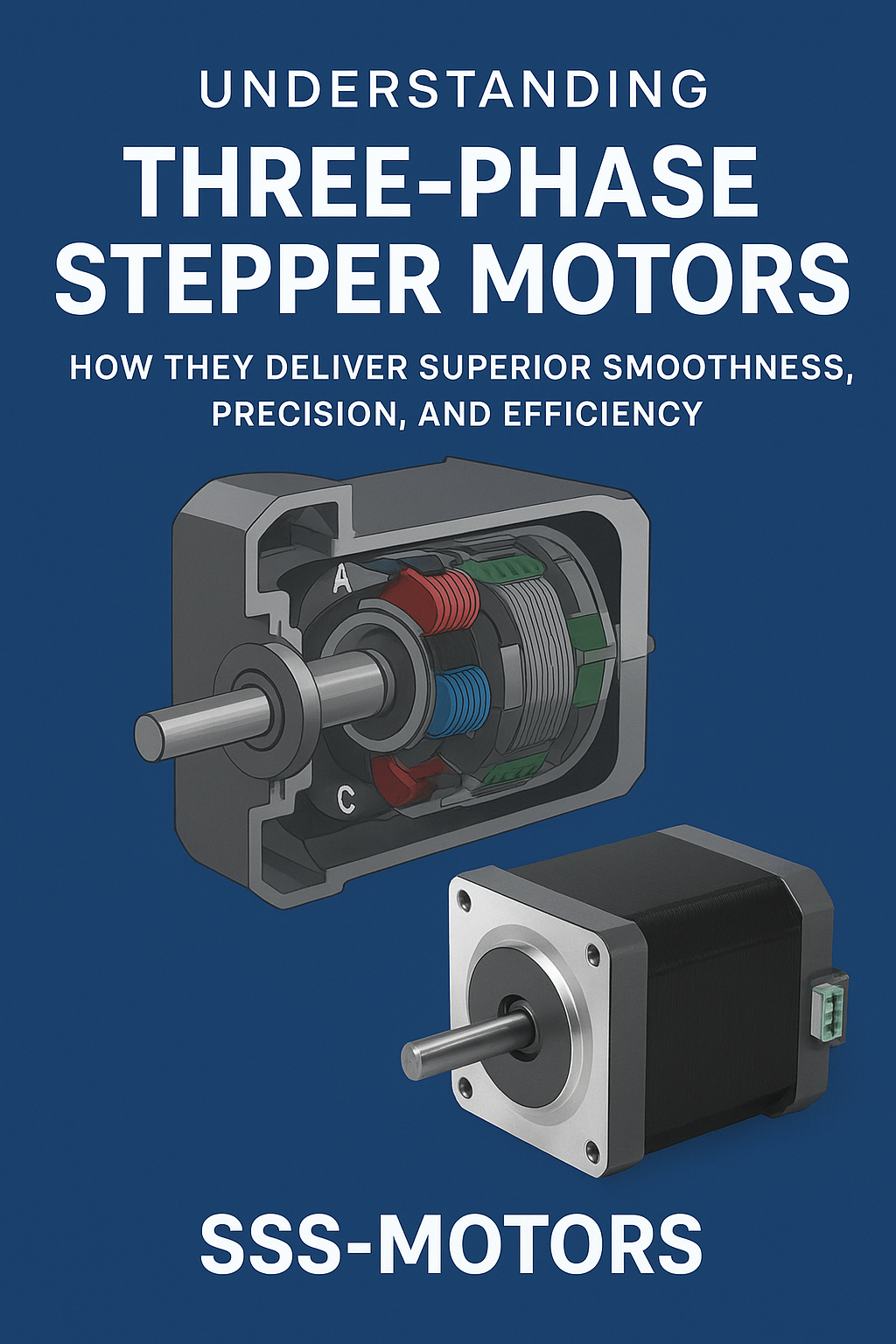
At its core, a three-phase stepper motor is still a stepper — it converts electrical pulses into precise mechanical rotation. But unlike a two-phase motor that energizes coils 90° apart, this one has three sets of windings spaced 120° apart.
Imagine three hands of a clock — evenly spaced, always pulling the rotor forward one tiny step at a time. Each pulse from the driver energizes the next phase, creating a rotating magnetic field that moves more fluidly and continuously.
That’s why engineers who switch from two-phase to three-phase systems often describe the movement as “buttery smooth.”
Because the three magnetic fields overlap more evenly, torque ripple — those tiny push-and-pull fluctuations that cause vibration — drops dramatically. Your machine runs quieter, even at low speeds, which is a big deal in medical devices, optical instruments, and high-precision 3D printers.
The typical step angle for a three-phase motor is 1.2°, compared to 1.8° for a standard two-phase. That’s already 33% finer motion — and when you combine it with microstepping drivers, it feels almost continuous.
Thanks to improved magnetic field utilization, three-phase motors often deliver more torque per unit size. At SSS-Motors, we’ve seen a 42mm (NEMA 17) three-phase stepper match the torque of a larger 57mm two-phase motor — with less heat and smoother operation.
| Feature | Two-Phase Motor | Three-Phase Motor |
|---|---|---|
| Coil Arrangement | 90° apart | 120° apart |
| Step Angle | 1.8° typical | 1.2° typical |
| Vibration | Moderate | Very low |
| Noise | Noticeable | Quiet and smooth |
| Efficiency | Standard | Higher |
| Best For | General automation | High-precision motion control |
A prototyping studio in California was using a Creality K1 Max 3D printer for architectural models. It worked fine — until they pushed for higher speed and detail. Suddenly, the printer produced ringing artifacts and an audible hum at low speeds.
We replaced the two-phase setup with a custom three-phase hybrid stepper system. The 120° phasing created smoother torque and reduced vibration almost completely.
“It was night and day. The hum and chatter disappeared. My printer now runs with a quiet purr — and the surface finish is flawless.”
Running a three-phase stepper motor isn’t complicated — you just need the right driver. Use a 3-phase brushless motor controller or a frequency drive for three-phase motors that supports 120° phase shifting.
Even if your shop runs on single-phase power, you can use a single to three phase VFD (1 phase to 3 phase VFD). It’s a simple, cost-effective way to run 220V 3 phase motors without rewiring your facility.
If you’re in any of these fields, three-phase motors aren’t overkill — they’re a real advantage:
Check out some compatible motion systems from SSS-Motors:
Most systems today use two-phase stepper motors because they’re “good enough.” But when you’re chasing higher quality — fewer vibrations, better surface detail, and quieter operation — “good enough” becomes the limit.
A three-phase stepper motor gives you that extra polish — not by adding complexity, but by refining how power flows through your system.
So if you’ve ever thought:
“My system works fine, but I wish it ran smoother…”
It might be time to look at your phases.
At SSS-Motors, we help engineers and makers choose the right motion solution — stepper, brushless DC, or servo. If you’re designing a printer, robot joint, or automation module, we’d love to help you optimize your setup.
Contact us today or explore our precision motor lineup: