Our Location
1103A Tianhui Building, Yeqin 1st Road, Longcheng Street, Shenzhen, Guangdong, China
1103A Tianhui Building, Yeqin 1st Road, Longcheng Street, Shenzhen, Guangdong, China
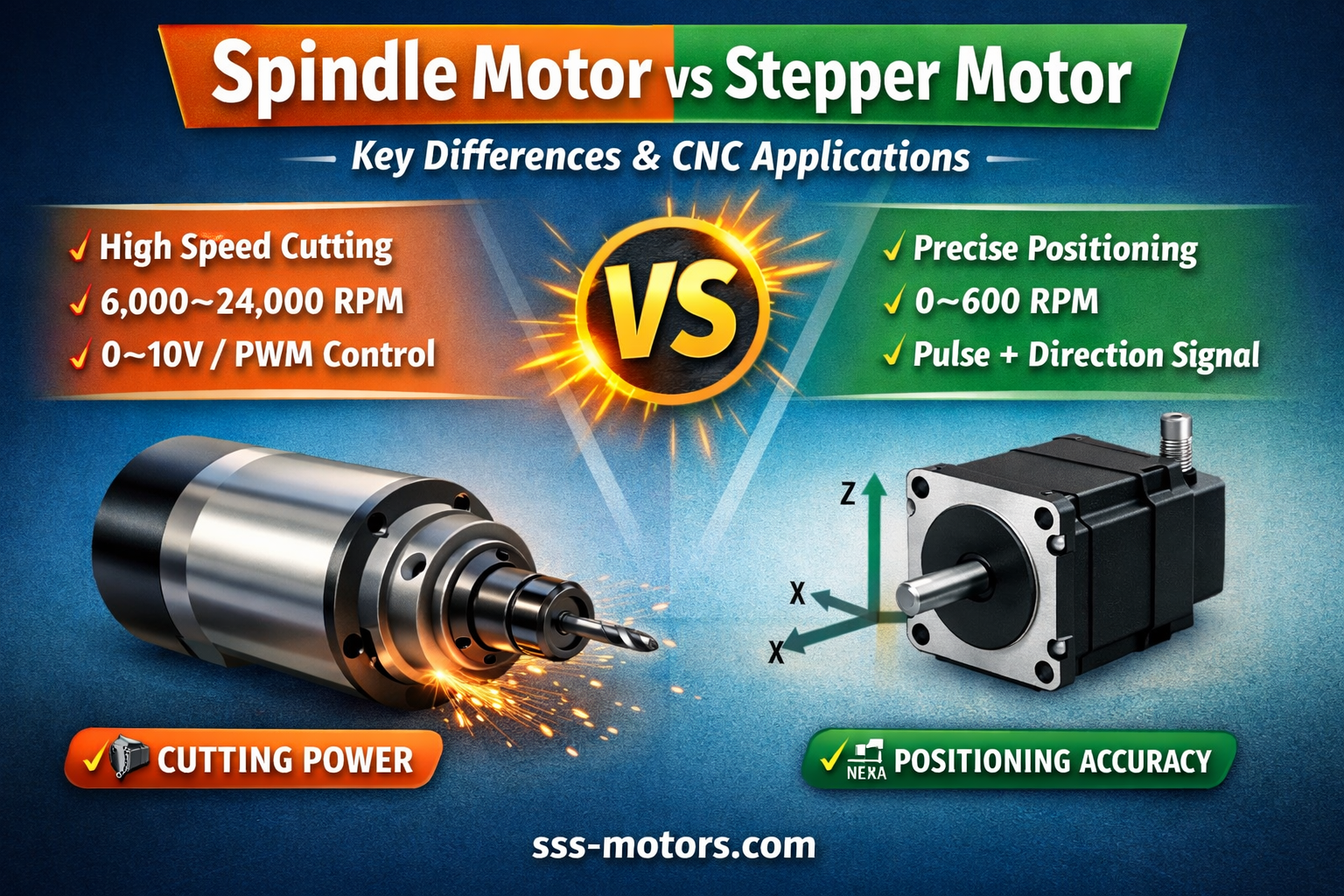
When selecting motors for CNC routers, engraving machines, automation equipment, or robotics systems, engineers often compare spindle motor vs stepper motor. Although both are essential motion-control components, their working principles, torque-speed curves, and application roles are completely different.
This technical guide from Shenzhen Sunshine Sea Technology Co., Ltd explains the engineering differences between spindle motors and stepper motors and helps machine designers select the correct solution.
Official website:
https://sss-motors.com
A CNC spindle motor is a high-speed rotating motor designed to drive cutting tools such as drills, end mills, engraving bits, and grinding wheels. It provides the rotational energy required for material removal.
Engineering summary:
Spindle motor = high-speed cutting power source
A stepper motor is a positioning motor that rotates in discrete angular steps (typically 1.8° per step). It is widely used for accurate axis motion in CNC machines.
Example industrial solution:
NEMA 17 stepper motor is commonly used in CNC router X/Y/Z axis positioning systems due to its balance between torque output and cost efficiency.
Engineering summary:
Stepper motor = precision positioning actuator
| Feature | Spindle Motor | Stepper Motor |
|---|---|---|
| Main function | Cutting tool rotation | Axis positioning |
| Typical speed | 8,000 – 24,000 RPM | 0 – 600 RPM |
| Low-speed torque | Low | High |
| High-speed torque | High | Very low |
| Control signal | 0–10V / PWM | Pulse + Direction |
| Position holding | No | Yes |
| Cooling requirement | Air / Water cooling | Natural dissipation |
| Main application | CNC spindle system | CNC axis motion |
The stepper motor torque speed curve behaves completely differently from the spindle motor torque curve.
For detailed technical explanation see:
stepper motor torque speed curve
Engineering rule:
Never use a stepper motor as a spindle motor.
Never use a spindle motor as a positioning motor.
| Axis | Motor Type | Function |
|---|---|---|
| X-axis | Stepper motor | Left/right positioning |
| Y-axis | Stepper motor | Front/back positioning |
| Z-axis | Stepper motor | Vertical positioning |
| Spindle | Spindle motor | Tool rotation |
Stepper motors control positioning accuracy.
Spindle motors provide cutting power.
No. Stepper motors lose torque rapidly at high speed and cannot maintain stable cutting rotation.
No. Standard spindle motors cannot hold angular position without encoder feedback.
No. Stepper motors are designed for positioning rather than continuous high-speed rotation required for machining.
Stepper motors position the tool accurately while spindle motors perform the cutting operation.
Most CNC spindle motors operate between 8,000 RPM and 24,000 RPM depending on machining requirements.
Standard stepper motors operate in open-loop control without encoders, although closed-loop stepper systems are available for higher precision applications.
Shenzhen Sunshine Sea Technology Co., Ltd specializes in:
Learn more:
If you are comparing different motion control motors for CNC or automation systems, the following technical guides may also help:
These comparison articles explain how different motor technologies perform in positioning systems, automation platforms, and CNC machines.
Understanding the difference between spindle motor vs stepper motor ensures proper CNC machine performance.
Stepper motors provide positioning accuracy.
Spindle motors provide cutting power.
Both motors are essential components in modern CNC motion systems.