Our Location
1103A Tianhui Building, Yeqin 1st Road, Longcheng Street, Shenzhen, Guangdong, China
1103A Tianhui Building, Yeqin 1st Road, Longcheng Street, Shenzhen, Guangdong, China
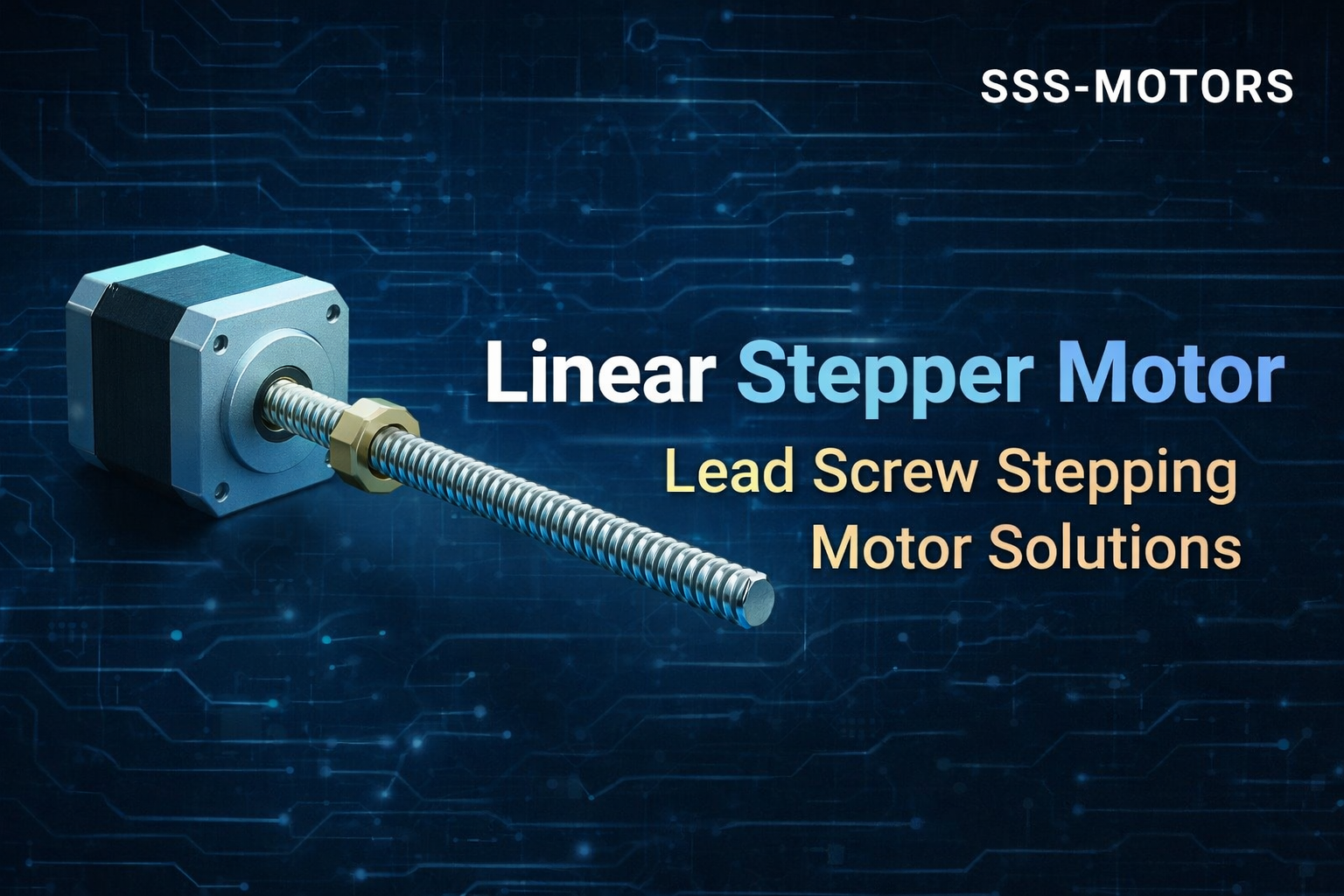
In modern automation and precision equipment, converting rotational movement into controlled linear displacement is a common requirement.
Stepper-based linear motion systems are widely used because they offer predictable positioning, stable thrust, and simplified control logic.
These systems are often referred to as integrated linear actuators, where the motor and mechanical transmission are combined into a compact unit.
You can explore various configurations available in our
linear motion actuator category
.
A lead screw driven actuator converts rotary motion into linear travel through a threaded screw and nut mechanism.
Each electrical pulse applied to the stepper motor results in a fixed increment of linear movement, allowing precise and repeatable positioning.
This principle is widely explained in mechanical engineering references such as
Wikipedia’s lead screw overview
, which describes why trapezoidal screw profiles are commonly used in industrial linear applications.
Compared with belt or rack-driven mechanisms, integrated linear actuators offer higher rigidity and reduced backlash.
The direct coupling between motor and screw improves system stability and simplifies mechanical alignment.
Many modern automation projects therefore adopt stepper motor linear actuator designs found in
dedicated linear actuator product ranges
, especially where compact installation space is required.
Stepper-based linear positioning solutions support microstepping control, which significantly increases resolution and smoothness.
This makes them suitable for laboratory instruments, medical devices, and inspection equipment.
For a deeper explanation of microstepping principles, you may also refer to
this technical overview on microstepping
, which explains how finer motion control is achieved electronically.
Lead screw based linear actuators are compatible with a wide range of drivers and power supplies.
Their flexibility allows easy integration into existing control architectures without extensive redesign.
When selecting a suitable solution, reviewing different
stepper-driven linear motion options
helps ensure the right balance between load capacity, speed, and positioning accuracy.
Stepper-based linear motion solutions play an important role in modern motion control systems.
By integrating a motor and screw mechanism into a single structure, these actuators provide reliable, precise, and efficient linear movement.
To compare specifications and available configurations, visit our complete
linear actuator category for stepper motors
.
Linear stepper motors are used for precise linear positioning in medical devices, laboratory automation systems, semiconductor equipment, and precision motion platforms.
Captive linear stepper motors include an integrated lead screw inside the motor, while non-captive versions allow external motion components for flexible system design.
Yes, linear stepper motors typically provide higher positioning accuracy compared with belt-driven motion systems.
Yes, external guide rails are usually required to support load stability and prevent side loading during operation.
The stroke length should match the required travel distance of the application while considering installation space and safety margin.
Linear stepper motors are best suited for light to medium load applications. Higher loads typically require ball screw actuator systems.


[…] For a deeper understanding of how linear stepper motors work and their benefits, check out our detailed article on Linear Stepper Motor Explained. […]