Our Location
1103A Tianhui Building, Yeqin 1st Road, Longcheng Street, Shenzhen, Guangdong, China
1103A Tianhui Building, Yeqin 1st Road, Longcheng Street, Shenzhen, Guangdong, China
What Makes a Stepper Motor Truly Closed Loop? | Closed Loop Stepper Motor Encoder
Many engineers and hobbyists assume that once a stepper motor is equipped with an encoder, it automatically becomes a closed loop stepper motor. However, that’s not entirely true. The key difference lies not in having an encoder, but in how the feedback signal is processed and used during operation.
This configuration is often called “open loop with feedback”. The motor does have an encoder attached, but the encoder only plays a monitoring role — it does not continuously correct the motor’s position in real time.
Analogy: Think of this as a manager giving instructions but checking results only at the deadline. If the result is wrong, it’s too late to correct it.
A true closed loop uses its encoder not just as a sensor, but as an active part of the control system. Encoder feedback is continuously sent to the stepper motor driver, which includes an internal PID position controller.
The controller constantly compares two signals:
If a deviation occurs, the controller immediately adjusts the output current to correct it — keeping the motor synchronized with the command.
Analogy: Like a coach guiding an athlete, correcting every small movement instantly to keep the performance perfect.
| Feature | Open Loop with Encoder | True Closed Loop Stepper Motor |
|---|---|---|
| Control Principle | Open loop control, no real-time correction | Closed loop control, continuous feedback |
| Encoder Function | Post-motion verification, alarm, or homing | Real-time feedback input to control loop |
| Step Loss Handling | Detects and reports lost steps | Prevents and corrects lost steps in real time |
| System Design | Encoder processed by external controller | Driver includes closed-loop algorithm internally |
| Motion Accuracy | Depends on load and torque | Maintains accuracy under dynamic loads |
| Error Response | Alarm only, no correction | Immediate current adjustment and recovery |
The key question isn’t “Does it have an encoder?” but rather:
Can the driver process encoder feedback for real-time position correction?
If the driver has a built-in closed-loop control system, it’s a genuine closed loop stepper motor.
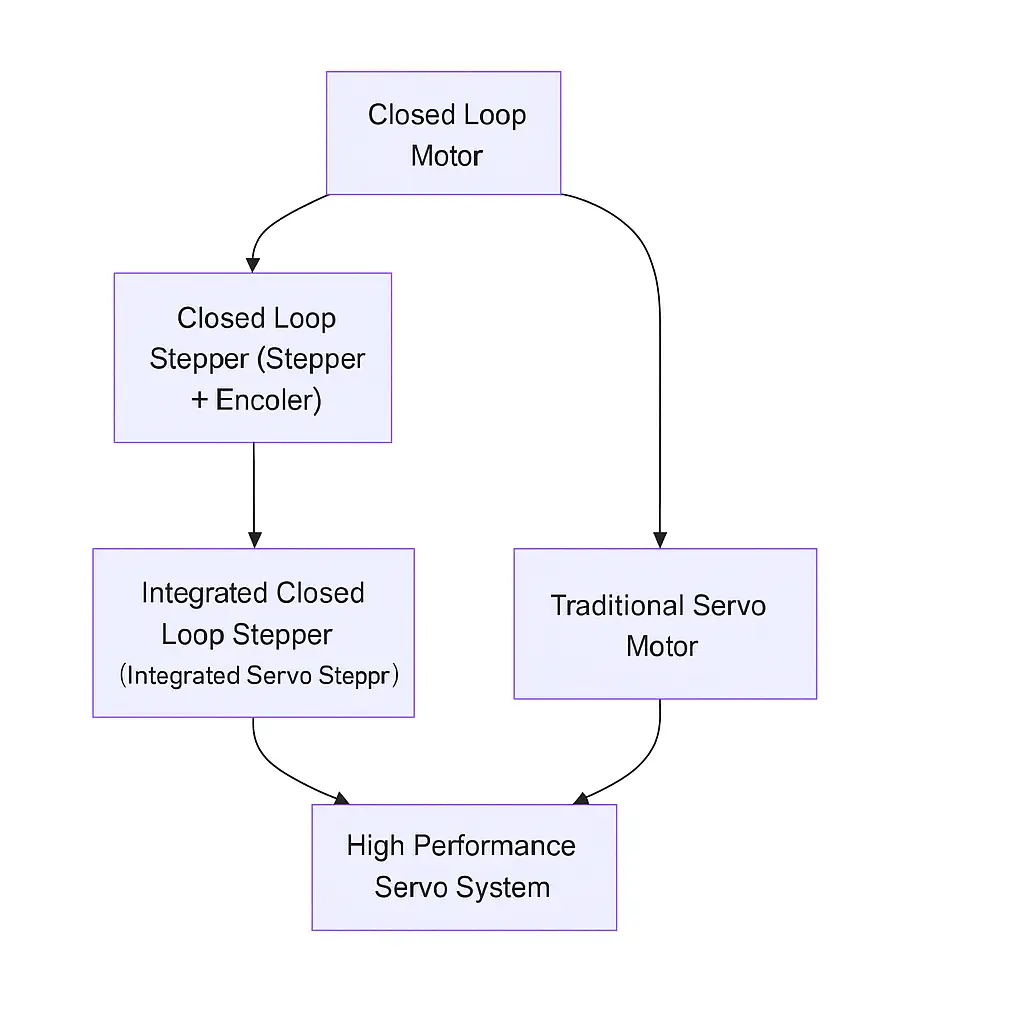
Our 57mm Closed Loop Stepper Motor is a true closed loop system. It combines a high-resolution encoder with a smart stepper driver that instantly corrects position errors in real time.
This design prevents step loss, eliminates overheating, and ensures optimal current use. Perfect for CNC machines, textile automation, and precision conveyors.
The NEMA 11 Integrated Closed Loop Stepper Servo Motor integrates the driver, controller, and encoder directly inside the motor housing. This minimizes signal delay and simplifies wiring, offering compact and reliable performance.
This integrated stepper motor is ideal for small automation systems, robotic arms, and 3D printers — combining servo-level precision with stepper simplicity.
Adding an encoder doesn’t automatically make a motor closed loop. Only when the driver actively uses encoder feedback for real-time corrections does it become a true closed-loop stepper.
For demanding applications that require precision and reliability, choose motors like our 57mm Closed Loop Stepper Motor or NEMA 11 Integrated Closed Loop Stepper Servo Motor. They combine the torque of a stepper motor with the intelligence of servo control — ensuring smooth and reliable operation.