Our Location
1103A Tianhui Building, Yeqin 1st Road, Longcheng Street, Shenzhen, Guangdong, China
1103A Tianhui Building, Yeqin 1st Road, Longcheng Street, Shenzhen, Guangdong, China
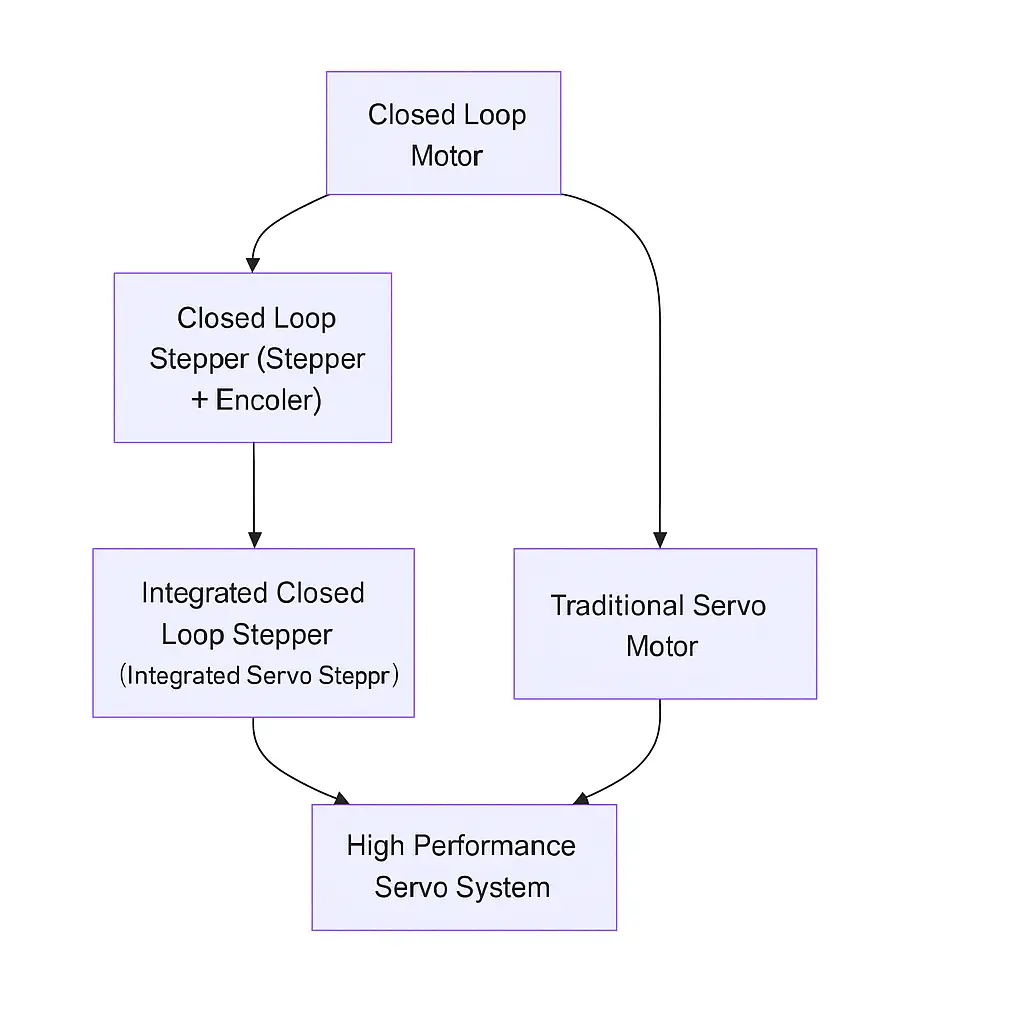
When choosing a stepper motor for your automation or CNC project, you might wonder what makes a closed loop stepper motor different from an open loop system. Are all closed loop motors integrated? Do you really need a feedback encoder? Let’s break it down and understand how closed loop control, integration, and motor selection work together for better performance and reliability.
Open loop stepper motors are the most traditional type used in various motion control systems. The controller sends a pulse command to the stepper motor driver, assuming the motor moves precisely according to the given steps. However, there is no feedback device to verify the actual position. If the load is too heavy or the motor stalls, the system won’t detect it — leading to missed steps and lost positioning accuracy.
By contrast, a closed loop stepper motor includes a feedback device, typically an encoder. The encoder constantly monitors the shaft position and sends real-time feedback to the driver. When the actual position deviates from the command (due to overload or mechanical disturbance), the driver instantly corrects the motion, ensuring precise synchronization between command and movement.
In short, “closed loop” means the motor can “see” its motion and adjust itself intelligently. This feedback mechanism bridges the gap between traditional stepper motors and servo systems, offering higher reliability and smoother operation.
| Feature | Open Loop Stepper Motor | Closed Loop Stepper Motor |
|---|---|---|
| Feedback | No feedback control | Encoder provides position feedback |
| Accuracy | Can lose steps under load | Auto-corrects position errors |
| Heat Generation | Runs constantly at rated current | Reduces current dynamically |
| Noise & Vibration | Higher noise and resonance | Smoother, quieter motion |
| Efficiency | Less efficient under variable load | Improved efficiency and torque utilization |
If you’re searching for the best closed loop stepper motor for 3D printer or precision automation, the closed loop system provides superior stability and consistent positioning performance.
Another common question is whether all closed loop stepper motors are integrated. The short answer: No.
“Closed loop” describes the control method, while “integrated” refers to the mechanical and electronic structure. A separated system uses three individual components: a stepper motor, a feedback encoder, and an external stepper motor driver. This setup offers flexibility — you can mix and match components from different brands and handle larger power requirements. However, it increases wiring complexity and installation time.
On the other hand, an integrated stepper motor combines the motor, driver, and encoder in a single compact housing. This “plug-and-play” design simplifies wiring and installation dramatically. The integrated version is ideal for space-limited applications such as desktop CNC machines, labeling equipment, and 3D printers.
| Feature | Separated Closed Loop System | Integrated Closed Loop Stepper Motor |
|---|---|---|
| Structure | Motor + Encoder + External Driver | All-in-one compact design |
| Flexibility | High (customizable components) | Low (fixed configuration) |
| Installation | More complex wiring | Plug-and-play simplicity |
| Size | Larger, requires space | Compact and lightweight |
| Power Range | Small to large systems | Usually small to medium |
For instance, our NEMA 11 Integrated Closed Loop Stepper Servo Motor combines feedback precision with a compact integrated driver design — perfect for applications demanding reliability and space efficiency.
Many engineers describe a servo stepper motor as a hybrid between a stepper and a servo. It maintains the precise positioning of a stepper motor while adding the smooth control and feedback of a servo system. In integrated designs, this results in faster response, reduced heat, and quieter operation — all without the high cost of full servo motors.
Compared to open loop designs, the closed loop control minimizes mechanical wear, prevents loss of position, and increases efficiency, making it one of the most reliable solutions for industrial automation.
Open loop control means the system sends motion commands but doesn’t verify if the target position is reached. It’s simple and low-cost but may lose accuracy under varying loads.
The difference between open loop and closed loop stepper motor lies in feedback. Closed loop motors use encoders for real-time correction, ensuring higher precision and efficiency.
No. While integrated stepper motors are closed loop by nature, not all closed loop systems are integrated. You can build a closed loop system using separate motor, encoder, and driver components.
An open loop control system operates without feedback. It assumes the command equals the outcome, making it simpler but less accurate compared to closed loop designs.
In summary, a closed loop stepper motor ensures precise feedback, reduced noise, and improved efficiency. Integrated versions further simplify design and installation — making them ideal for modern automation systems. If you’re looking to upgrade your equipment, consider choosing a closed loop model to enjoy the benefits of servo-like performance at a stepper-level cost.
👉 Explore our Closed Loop Stepper Motor Series for high-performance, compact integrated solutions.