Our Location
1103A Tianhui Building, Yeqin 1st Road, Longcheng Street, Shenzhen, Guangdong, China
1103A Tianhui Building, Yeqin 1st Road, Longcheng Street, Shenzhen, Guangdong, China
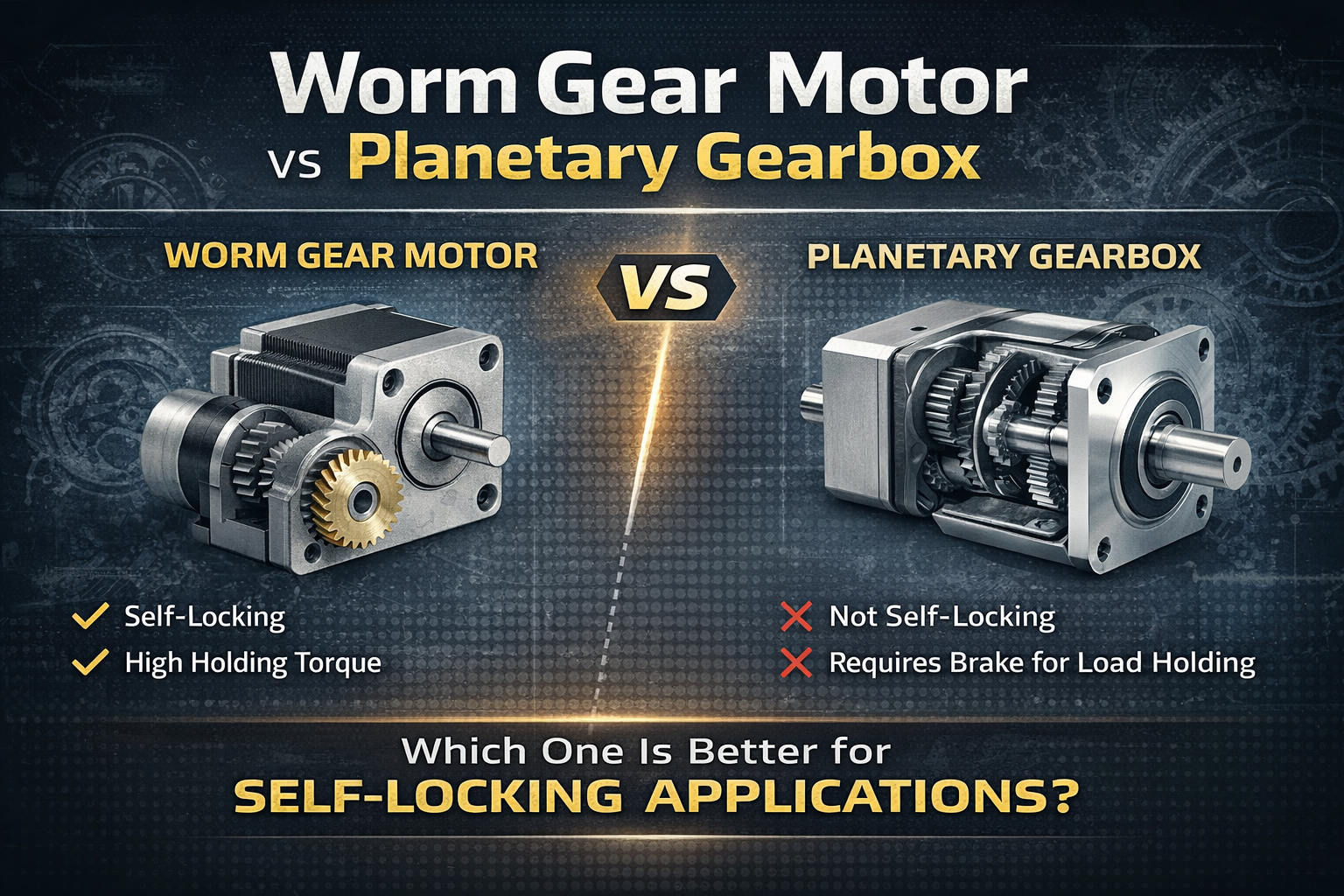
In many industrial and automation projects, self-locking is a critical safety requirement. A worm gear motor is often selected because it can hold position securely when power is removed, preventing unintended movement under load. Compared with a planetary gearbox, this type of geared motor offers a mechanical advantage that eliminates the need for an external brake.
A worm gear drive consists of a motor combined with a worm gearbox that transmits motion at a right angle. Due to the friction angle between the worm and the gear wheel, reverse rotation is mechanically restricted. This design allows the output shaft to resist back-driving even under constant load.
For compact automation systems, solutions such as the NEMA 17 self-locking worm gearbox motor are commonly used in vertical positioning and load-holding applications.
Planetary gearboxes are known for their high efficiency and compact torque transmission. However, they are inherently back-drivable. When electrical power is removed, the load can rotate the output shaft in reverse, which introduces safety concerns in lifting or positioning systems.
To compensate for this limitation, planetary systems often rely on additional brakes or locking mechanisms, adding cost and complexity to the overall design.
| Feature | Worm Gear Drive System | Planetary Gearbox |
|---|---|---|
| Self-Locking | Yes, mechanical | No |
| Back-Driving | Prevented | Possible |
| External Brake | Not required | Usually required |
| System Safety | High | Brake-dependent |
Worm-based gear solutions are optimized for low-speed, high-torque output. Although efficiency is lower than planetary designs, this trade-off is acceptable in applications where holding torque and safety take priority over continuous motion efficiency.
If your application involves vertical loads, frequent stops, or position holding after power loss, a worm gear motor is the more reliable choice. A compact example is the NEMA 17 worm gearbox solution, which integrates speed reduction and self-locking into a single drive unit.
For self-locking applications, worm-driven gear systems provide superior safety and simplicity. Planetary gearboxes remain ideal for high-efficiency motion, but they cannot replace the inherent load-holding advantage of a worm-based drive.