Our Location
1103A Tianhui Building, Yeqin 1st Road, Longcheng Street, Shenzhen, Guangdong, China
1103A Tianhui Building, Yeqin 1st Road, Longcheng Street, Shenzhen, Guangdong, China
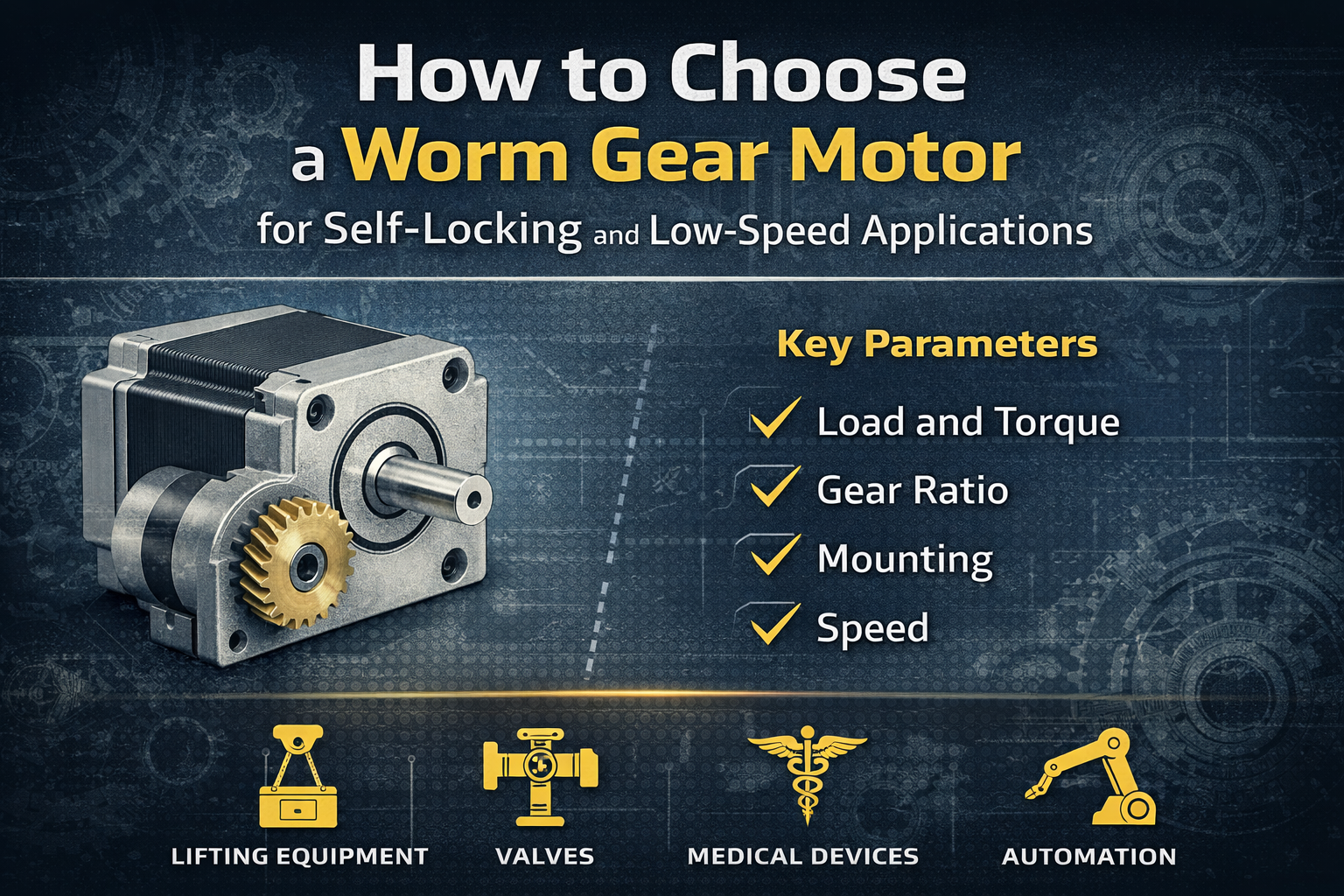
In many motion control systems, self-locking is essential for safety and positional stability. When power is removed, the drive system must be able to hold the load without slipping or back-driving. For this reason, engineers often evaluate a worm gear motor when designing vertical or load-holding mechanisms.
A worm gear drive uses the interaction between a worm and a gear wheel to transmit motion at a right angle. Due to the friction characteristics of this gear geometry, reverse rotation is naturally restricted. This allows the system to resist back-driving under load without relying on external braking components.
The first step in selection is determining the required holding torque. The gearbox must provide sufficient torque to support the load in a static condition, especially when the motor is powered off.
Worm gear systems are best suited for low-speed operation. If the application prioritizes smooth positioning and controlled movement rather than high efficiency, a worm-based drive is often the preferred solution.
Higher gear ratios improve torque output and self-locking behavior but reduce mechanical efficiency. In many positioning and lifting applications, this trade-off is acceptable because safety and stability are more important than continuous high-speed operation.
Vertical installations place higher demands on load-holding performance. When selecting a worm gearbox solution, consider whether the motor will be mounted vertically, horizontally, or at an angle, as this directly affects load behavior.
In these applications, compact self-locking gear solutions simplify system design by eliminating the need for additional brakes or locking devices.
When space is limited, a compact frame size can still deliver reliable load-holding performance. For example, a NEMA 17 worm gear motor for self-locking applications offers a balance between size, torque, and mechanical stability.
Before finalizing your design, confirm that the selected drive system can safely hold the load, operate at the required speed, and fit within the available installation space. A properly selected worm-based gear solution improves reliability, simplifies control, and enhances overall system safety.